
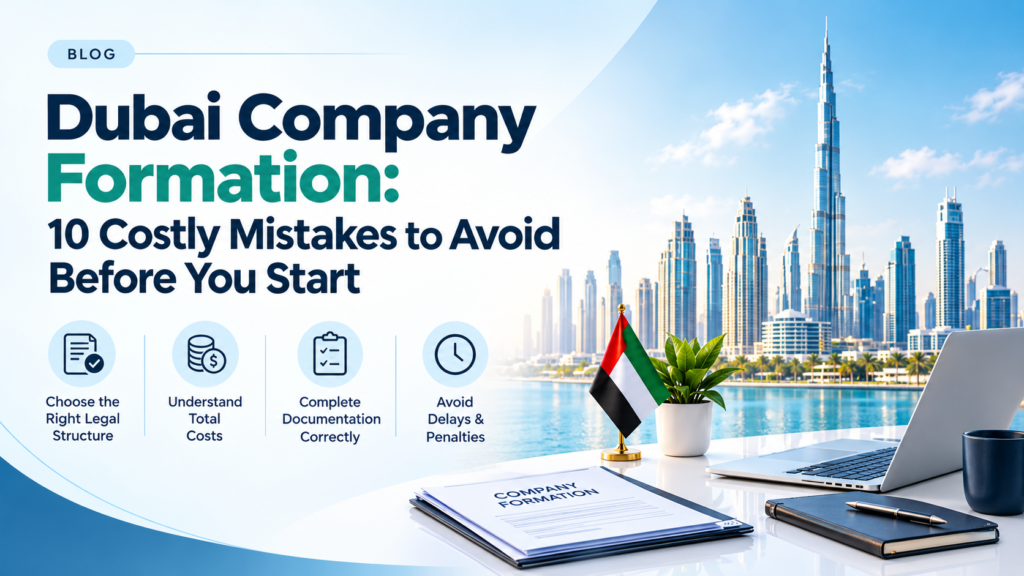
Setting up a company in Dubai can be straightforward when the business activity, jurisdiction, licence, documentation and compliance requirements are aligned from the beginning.
The problems usually start when entrepreneurs make important decisions based on a low advertised price, a generic setup package or incomplete information.
A company may be legally incorporated but still have the wrong business activity, unsuitable premises, inadequate visa capacity, banking difficulties or unexpected compliance obligations.
That is why the real question is not:
“How quickly can I get a Dubai trade licence?”
It is:
“Am I setting up the right company for what I actually plan to do?”
Below are 10 of the most important mistakes to avoid before and during Dubai company formation, along with practical ways to prevent them.
The first three mistakes happen before the application even starts. The remaining mistakes can create problems during formation or after the licence has been issued.
One of the most common mistakes is starting with:
“Which is the cheapest free zone?”
That is the wrong first question.
The better starting point is:
“What exactly will my company do, who will it sell to, and where will it operate?”
Your business model can influence whether mainland or free zone is more appropriate, which activities you need, what office arrangements may be required and how easily the structure can support your future plans.
For example, a consultancy serving international clients may have very different requirements from a trading company that needs warehousing, a business serving the UAE mainland market or a regulated professional activity.
Choosing the wrong jurisdiction can result in:
The cheapest licence at incorporation is not necessarily the cheapest structure over three years.
Define these five things before choosing a jurisdiction:
Only then compare mainland and free-zone options.
If you are considering a free zone, use OfinGlobal’s guide on how to choose the right free zone in Dubai rather than comparing licence prices alone.
A good consultant should explain why a particular jurisdiction fits your business rather than simply presenting the cheapest package.
Your company licence needs to reflect the activities the business is actually intended to conduct.
A founder might describe the business as “consulting,” for example, while the actual business involves consulting, marketing, software services, recruitment, trading or another activity.
Those are not automatically interchangeable.
Entrepreneurs often:
Your business activity can affect:
A licence that does not accurately reflect the business model can create unnecessary amendments or restrictions later.
Before applying, write down:
What do we sell?
How do we make money?
Who pays us?
What services or products will we provide?
What additional activities could we reasonably add within the next 12–24 months?
Then map those activities against the licensing options available in your chosen jurisdiction.
This is one area where professional guidance can be useful—not because a consultant should decide your business model for you, but because the proposed activities should be checked against the licensing framework before you submit the application.
“Company formation from AED X” looks attractive.
But the headline number may represent only one part of the actual cost.
A realistic budget may also need to account for:
Comparing:
Package A = AED 8,000
with:
Package B = AED 12,000
without checking what each package actually includes.
Ask for a complete first-year cost breakdown.
Then separately calculate:
Initial setup cost + visas + premises + compliance + annual renewal + expected operating costs
This gives you a much more realistic picture of what the business will require.
For mainland businesses specifically, OfinGlobal’s detailed Dubai mainland company formation cost guide can be used to understand the different cost components rather than relying on a headline package price.
Never compare two setup packages by the licence price alone.
Compare what the company will cost to establish and maintain.
Getting a trade licence is a major milestone.
It is not the same as being completely operational.
Depending on your business, you may still need:
This distinction is particularly important when planning a launch date.
Milestone 1: Legally established
The company has been incorporated and the applicable licence has been issued.
Milestone 2: Founder/team ready
Required visas, immigration procedures and identification processes have been completed.
Milestone 3: Operationally ready
The business has the premises, banking, accounting, tax and other requirements needed to actually operate.
These milestones may happen at different times.
For a detailed explanation of the process itself, see OfinGlobal’s Dubai mainland company formation guide.
A common mistake is to choose a licence first and think about premises and visas later.
That can create problems if the business requires a particular type of office, additional approvals or a specific visa capacity.
Your premises can also affect:
For mainland businesses, office requirements can be particularly important.
Before committing to a structure, determine:
OfinGlobal’s guide to Dubai mainland office requirements, Ejari, space and visa quota can help with this planning.
Do not choose the licence first and discover the premises requirements afterward.
This is one of the biggest practical mistakes founders make.
They think:
“Once I have the trade licence, I’ll open the bank account.”
But company formation and corporate banking are separate processes.
A bank may evaluate:
A valid UAE trade licence does not guarantee that a particular bank will accept the company.
Imagine the company has:
but the founder cannot yet use a suitable corporate account for normal business transactions.
The company exists.
The business is still not fully operational.
Think about banking before incorporation.
Your business activity, ownership structure and operating model should make sense not only to the licensing authority but also to the financial institution that may eventually onboard the company.
This is particularly important for:
If banking is important to your business model, treat it as a structuring consideration—not a final administrative step.
Another common mistake is thinking:
“I’ll deal with tax and accounting after the company starts making money.”
That approach can create unnecessary problems.
From the beginning, the company should have a plan for:
The exact obligations depend on the company’s circumstances, activities, revenue and applicable UAE rules.
Good accounting is not simply about preparing a tax return.
It helps the company:
If you need ongoing financial support after incorporation, OfinGlobal provides accounting services in Dubai.
For businesses that fall within applicable audit requirements, OfinGlobal also provides auditing services in Dubai.
Set up your accounting process when you establish the company, not when your first tax deadline approaches.
Documentation problems are among the easiest formation delays to prevent.
Typical issues can include:
International shareholders can also face additional documentation requirements depending on their circumstances.
A missing document may sound minor.
But a request for clarification can pause an application and create a chain reaction:
Document delay → approval delay → licence delay → visa delay → operational delay
Create a document checklist before submitting anything.
Check:
Ofin Global’s documents required for mainland company formation in Dubai guide can be used as a starting checklist.
Many founders plan only until the licence is issued.
That’s where the planning should continue—not stop.
After incorporation, you may need to manage:
A company can be correctly incorporated but poorly managed afterward.
The founder then discovers:
“I didn’t know I had to do that.”
This is particularly common when the business owner is new to UAE compliance.
At minimum, track:
Licence renewal date
Visa expiry dates
Tax deadlines
VAT deadlines, where applicable
Accounting close
Audit requirements, where applicable
Corporate documents and filings
Employee-related obligations
This turns compliance from a surprise into a predictable operating process.
If you want a broader view of what happens after incorporation, this is also the area where OfinGlobal’s planned After Company Formation in Dubai: What Happens Next? resource can eventually become a natural next step in the cluster.
The final mistake is assuming that every “business setup consultant” provides the same service.
They don’t.
Some providers focus primarily on incorporation.
Others may also help with:
Choosing a provider based on:
“Who quoted the lowest price?”
instead of:
“Who understands the business I am actually building?”
A consultant should also be transparent about what they cannot guarantee.
No consultant should promise that a particular government authority or bank will approve an application simply because the consultant is handling it.
Before you submit your Dubai company formation application, ask yourself:
If you cannot confidently answer several of these questions, the company may not yet be ready for incorporation.
The biggest lesson from these mistakes is that company formation should be treated as a business-structuring decision, not a paperwork exercise.
A better sequence is:
What are you selling?
Which licensed activity actually describes it?
Mainland or suitable free zone?
Office, visas, approvals and staffing.
Will the proposed business structure make sense for a corporate bank?
Not just the licence price.
Before submitting the application.
Complete the required registration and licensing process.
Visas, banking, accounting and other requirements.
Renewals, tax, accounting, audit and other obligations.
This sequence reduces the chance of solving one problem only to create another later.
A good consultant can reduce the risk of avoidable mistakes, but professional assistance does not replace the entrepreneur’s own decisions.
The consultant’s role should be to help you understand:
The consultant should explain the reasoning, not simply hand you a package.
And there is an important distinction:
A consultant can reduce process risk. They cannot guarantee government approval, immigration decisions or bank account approval.
Before paying a formation provider, score your preparation.
Give yourself 1 point for every “yes”:
8–10: Your setup plan is reasonably well defined.
5–7: Several important decisions still need attention.
0–4: Do not rush into incorporation. Start with the business structure.
The purpose of this score is not to tell you whether you need a consultant.
It is to tell you whether you understand the setup you are about to buy.
OfinGlobal approaches UAE company formation as more than obtaining a trade licence.
The process starts by understanding the business activity, then evaluating the appropriate jurisdiction, structure, licensing requirements, banking considerations, visa requirements and ongoing tax, accounting and compliance needs.
That means the goal is not simply:
“Get the licence.”
It is:
“Build the right structure for the business and understand what happens after the licence is issued.”
OfinGlobal supports company formation across mainland and free-zone jurisdictions, along with banking assistance, visas, accounting, tax advisory and post-formation compliance.
Most Dubai company formation problems do not begin when the application is submitted.
They begin earlier.
They begin when an entrepreneur:
The safest approach is to work backwards from the business you actually want to operate.
Define the activity.
Choose the right structure.
Understand the complete cost.
Plan banking, visas and premises.
Prepare the documents properly.
Build the compliance process from the beginning.
And if you use a business setup consultant, choose one that explains the reasoning behind the recommendation rather than simply selling you a licence package.
That is how you avoid turning a seemingly simple company formation into an expensive restructuring exercise later.
Choosing a structure before properly understanding the business activity and operating model is one of the most consequential mistakes. The wrong activity or jurisdiction can affect licensing, premises, banking, visas and future expansion.
Not necessarily. A low initial price may exclude visas, office costs, registration charges, accounting, tax compliance, renewals or other requirements. Compare the complete first-year and recurring cost instead.
Depending on the jurisdiction and activity, amendments or additional activities may be possible. However, it is better to identify the required activities before incorporation to avoid unnecessary changes later.
No. Banking is a separate approval process. Banks conduct their own due diligence and assess the company, shareholders, business model, source of funds and other factors.
Office requirements depend on the jurisdiction, business activity and company structure. Some setups may have flexible workspace options, while other activities require specific premises.
Commonly overlooked costs include visas, office space, establishment or immigration-related charges, accounting, tax compliance, audit where applicable, licence renewal and other recurring operational expenses.
It depends on your experience, business complexity and how comfortable you are handling activity selection, jurisdiction choice, documentation, licensing and post-formation requirements yourself. The value of a consultant is greatest when the setup has multiple moving parts or when a wrong decision could be expensive to correct.
No legitimate consultant should guarantee a government or bank decision. A consultant can coordinate the process and improve preparation, but final approval remains with the relevant authority or financial institution.
Starting a company in Dubai? Learn 10 costly mistakes involving activities, jurisdiction, licensing, documents, visas, banking, tax and compliance
Apply nowOur expert will contact you within 24 hours!

UAE:
Happyhearts Corporate Services FZCO, DSO-IFZA, IFZA Properties,
Dubai Silicon Oasis
Mob: +971 50 523 5779
Email: support@ofinglobal.com
India:
Address: C – 3, Shanti Bhuvan, Dr Rajendra Prasad Rd, Mulund West, Mumbai 400080
Mob: +91 9410 247 247
