
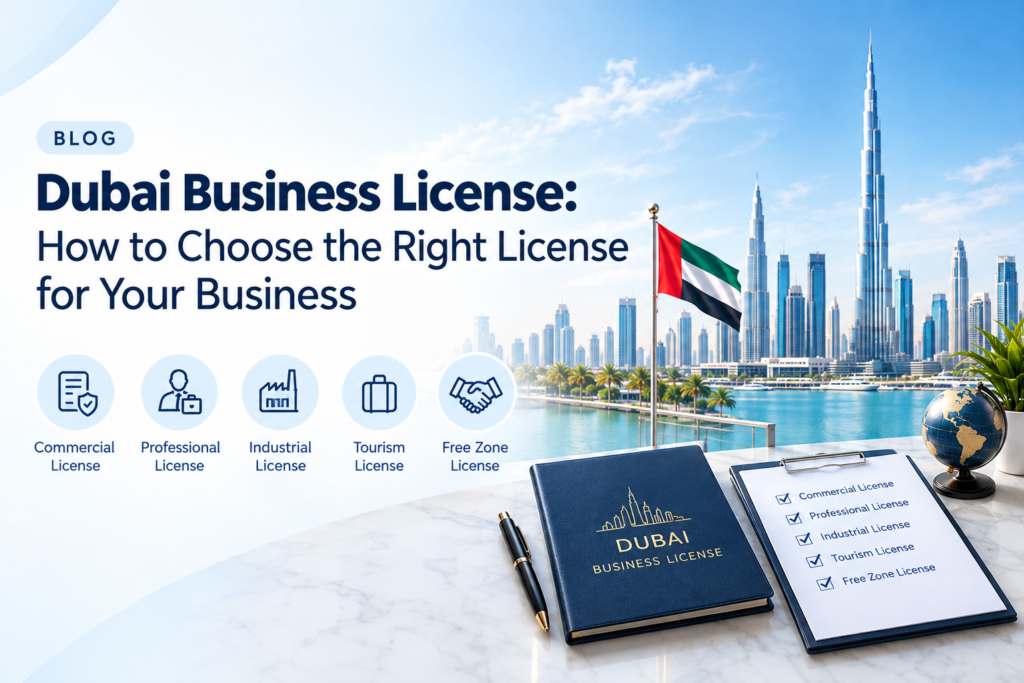
Choosing a business licence in Dubai is not simply a matter of picking between a commercial, professional or industrial licence.
The correct licence depends on what your company actually does, how it generates revenue, where it operates, which activities you need to register, and whether additional approvals or premises are required.
Dubai’s official business setup guidance places licence selection alongside decisions about the business activity, legal form, foreign ownership eligibility and additional approvals.
Mainland companies are licensed through the Dubai Department of Economy and Tourism (DET), while free zones operate under their respective authorities and rules.
That means choosing the wrong licence can create problems later with operations, approvals, premises, banking, visas or expansion.
This guide explains how to choose the right Dubai business licence based on your actual business model, rather than simply matching your company to a licence category.
Your starting point should be your actual business activity, not the licence package being advertised.
A simplified framework is:
What will your company do?
↓
What specific economic activity describes that work?
↓
Which licence category supports that activity?
↓
Which jurisdiction permits the activity — mainland or a particular free zone?
↓
Are additional approvals required?
↓
What premises, visa and operational requirements apply?
↓
Will the structure still work when your business expands?
For example:
Dubai’s official guidance currently lists five main mainland licence types: industrial, commercial, professional, E-Trader and dual licence.
The exact activity and licensing route, however, matter more than the label alone.
One of the biggest mistakes founders make is treating these three terms as interchangeable.
They are not.
This describes what the company is actually authorised to do.
Examples can include consulting, trading, software-related activities, manufacturing, logistics or other economic activities.
The licence is the regulatory authorisation under which the business conducts its permitted activities.
This determines where the company is established and which authority regulates it.
For example:
The relationship looks like this:
Business model
→ Activity
→ Licence
→ Jurisdiction
→ Approvals & operating requirements
This distinction is important because selecting a jurisdiction first and trying to fit the business into whatever licence package is available can lead to an unsuitable structure.
If you are still deciding between mainland and free zone, start with our guide on how to choose the right free zone in Dubai rather than selecting a zone purely because of its advertised package price.
Before looking at licence types, describe your business in plain English.
Don’t start with:
“I need a professional licence.”
Start with:
“I provide digital marketing services to companies in the UAE and overseas.”
Or:
“I import consumer products and sell them to distributors.”
Or:
“I manufacture packaged food products.”
Or:
“I develop software and provide implementation services to businesses.”
This matters because the same broad industry can contain very different economic activities.
Your answers create the starting point for activity selection.
Your company may do several things, but one question is particularly useful:
“What activity will generate most of my company’s revenue?”
For example, imagine a company that:
Simply calling the company a “digital company” is not enough.
You need to identify the actual activities the business intends to conduct and determine which activities can be licensed together under the relevant authority.
This is also where you should review our guide on how to choose the right business activity for a Dubai company once you have defined your business model.
Your activity can influence:
The Dubai government itself advises businesses to choose their licence and activity and check whether additional approvals are needed before starting the registration process.
Once you know what your business does, you can start evaluating the appropriate licence category.
A commercial licence generally relates to businesses involved in buying and selling goods and other commercial activities.
Dubai’s official guidance includes activities involving the buying and selling of goods and services, as well as areas such as import/export, logistics, physical products, software, construction and real estate within its commercial licensing framework.
Typical businesses that may need to investigate commercial activities include:
However, don’t assume that every business selling something automatically falls under the same activity.
The specific activity code and licensing authority requirements still need to be checked.
Professional licensing is generally associated with businesses or individuals providing professional services based on intellectual, technical or artistic abilities. Dubai’s official guidance gives professional services as a distinct mainland licensing category.
Potential examples may include:
The exact activity should still be verified with the relevant licensing authority.
A company calling itself a “consultancy” does not automatically mean every consulting activity follows exactly the same licensing route.
An industrial licence is relevant to businesses involved in manufacturing and certain production-related activities.
Dubai’s official guidance includes manufacturing, production, packaging, segregation and collection activities under the industrial category.
If your business involves manufacturing, ask additional questions about:
An industrial setup should therefore be evaluated as an operating model, not simply as a licence purchase.
Dubai also provides an E-Trader licence for certain home-based individual entrepreneurs selling products or services through social media and other online platforms. The eligibility and legal-form conditions are important, so businesses should verify whether this route actually applies to them rather than assuming any online business qualifies.
This is particularly important because:
“I sell online” does not automatically mean “I need an E-Trader licence.”
An online store operated as a company may have different licensing requirements depending on its activity, structure and jurisdiction.
Dubai’s official guidance also identifies a dual licensing route for certain companies operating in specific free zones that want to extend their presence to the mainland. Availability and conditions depend on the applicable free zones and requirements.
This is another example of why the question:
“Which licence is cheapest?”
is not enough.
The better question is:
“Which licensing structure gives my business the permissions and operating model it actually needs?”
This is a common planning mistake.
Suppose you run an online store selling:
The fact that customers place orders through a website does not by itself describe the complete economic activity.
You need to consider:
What are you selling?
Are you importing it?
Are you manufacturing it?
Are you storing it?
Are you reselling it?
Where are your customers?
Where is inventory held?
How is fulfilment handled?
The online channel is only one part of the business model.
The underlying activity remains important.
After identifying your activities, determine which jurisdiction supports your operating model.
Dubai provides both mainland and free-zone setup options. Mainland businesses are regulated through DET, while free zones have their own authorities, rules and licensing frameworks.
There is no universal “best” jurisdiction.
The correct question is:
Which jurisdiction supports the way I intend to operate?
This is one of the most important steps.
Don’t rely only on descriptions such as:
“Consulting licence”
or:
“Trading licence”
Ask for the specific activity or activities being registered.
Dubai’s Invest in Dubai platform provides activity-level information, including activity descriptions, competent entities, applicable legal forms and licence types for individual activities.
For example, an activity entry can specify:
That means your consultant should be able to explain the actual activity being proposed rather than simply giving you a generic licence label.
“What exact activity will appear on my licence?”
“Can you show me the activity description?”
“Can I add another related activity?”
“Are any additional approvals required?”
“Does this activity work in the jurisdiction you are recommending?”
If the answers are unclear, stop and investigate before paying.
A business licence does not necessarily mean that every regulatory requirement has been completed.
Dubai’s official guidance specifically states that some activities and company types require approvals from other government departments or agencies.
Depending on your activity, you may need to investigate additional requirements involving the relevant authority or regulator.
This is especially important for businesses operating in regulated or specialised sectors.
“Does my activity require approval from another authority?”
“Has that approval been included in the setup plan?”
“Can I obtain the approval before committing to the licence structure?”
“Will the premises need to meet any special requirements?”
This step can prevent one of the most expensive mistakes in company formation: obtaining a licence and only afterwards discovering that the intended operation requires something else.
Your business licence and premises should make sense together.
A founder might initially choose a low-cost setup package and later discover that the business requires a physical office, warehouse, specialised premises or another type of facility.
For mainland businesses, review the practical requirements in our guide to Dubai mainland office requirements, Ejari and visa quota.
Ask:
The cheapest licence is not necessarily the cheapest operating structure.
Your visa requirements should be part of the original calculation.
Ask:
A company formation package that works for one shareholder and no employees may not work for a company planning to hire ten people.
So don’t ask only:
“How much is the licence?”
Ask:
“What will the complete setup cost be based on my actual visa requirements?”
Corporate banking should not be treated as an afterthought.
Before incorporating, consider whether your business model can be clearly explained and supported through the company’s:
This does not mean a particular licence guarantees bank approval.
It means your company formation decisions should be consistent with the business you intend to operate.
A useful question for your consultant is:
“What should I prepare for corporate banking before incorporation?”
This can help you avoid choosing a structure without considering the practical requirements that come afterwards.
Another common mistake is assuming:
Licence = Company structure
They are related, but they are not identical.
Dubai’s official setup guidance treats licence selection and legal-form selection as separate decisions. Mainland legal forms can include structures such as LLCs, sole establishments, civil companies and other forms, depending on the circumstances and applicable rules.
Your legal structure should be considered based on factors such as:
Therefore, when a consultant recommends a licence, ask:
“What legal form are you recommending with this licence, and why?”
Many activities allow 100% foreign ownership, but Dubai’s official guidance notes that certain strategic sectors and activities can have restrictions or specific requirements.
So don’t make assumptions based purely on:
“Dubai allows 100% foreign ownership.”
Instead ask:
“Does my exact activity qualify for the ownership structure I want?”
If ownership is important to your setup, verify it at the activity level.
Before selecting a licence, run your business through this framework.
What exactly does the company do?
What products or services generate revenue?
Which specific economic activities describe those operations?
Which licence category supports those activities?
Can the activity be carried out under the proposed mainland or free-zone structure?
Does another government or regulatory authority need to approve the activity?
What office, warehouse or facility is required?
How many visas do you need now and potentially later?
Can you clearly document and explain the intended business model?
Can you add the activities, employees or operations you expect in the future?
If you cannot answer these ten questions, you are probably not ready to choose the licence package.
The following examples are simplified planning examples. The exact activity and licence should always be verified with the relevant authority.
Business model:
Providing SEO, advertising and digital marketing services to companies.
Questions to investigate:
Don’t choose a licence simply because it says “consultancy” without checking whether the actual services match the registered activity.
Business model:
Importing consumer products and selling them to businesses in the UAE.
Questions to investigate:
The licence decision should therefore begin with the products, not simply the word “trading.”
Business model:
Selling products through an online store.
Questions to investigate:
The website is the sales channel. The underlying business activity still needs to be identified.
Business model:
Manufacturing and packaging products in Dubai.
Questions to investigate:
This is fundamentally different from purchasing a simple service-company licence.
Business model:
Developing software and providing technology services to businesses.
Questions to investigate:
Again, the correct answer depends on the actual activities rather than the broad description “tech company.”
This is where licence selection becomes more complicated.
Imagine you want to:
You should not automatically assume that one generic licence covers all four.
Ask:
“Can these activities be registered together under the proposed structure?”
Then ask:
“If not, which activity should be primary and what would be required to add the others?”
Also consider your future business model.
If you know that a second revenue stream is likely within six months, it can be useful to consider that before finalising the initial structure.
This is one of the biggest traps in Dubai company formation.
Suppose Consultant A quotes a low first-year package.
Consultant B quotes a higher package.
That does not tell you which structure is actually more economical.
Your real comparison should look like:
Licence
Government fees
Office
Visas
Additional approvals
Banking preparation
Accounting
Tax compliance
Renewal
Future changes
This is why you should compare the total cost of operating the structure, not just the advertised licence price.
For a deeper breakdown of mainland costs, see our guide to Dubai mainland company formation cost.
Before accepting a low-cost package, ask five questions:
Then ask:
“What will I realistically spend during the first 12 months?”
This produces a much more useful number than the headline package price.
The licence should follow the business model, not the other way around.
Low upfront pricing can hide additional costs.
E-commerce is a sales model; the underlying activity still matters.
Some activities require approvals beyond the basic licence.
Your activity may affect what type of premises you need.
Visa requirements and capacity depend on the relevant setup and applicable rules.
Each free zone has its own rules and activity coverage.
The cheapest structure today may become inconvenient when your business expands.
A licence does not guarantee corporate bank approval.
Always understand what your company is actually authorised to do.
Use this as a starting point.
Yes → Investigate industrial licensing and premises/approval requirements.
No → Continue.
Yes → Investigate commercial/trading activities.
No → Continue.
Yes → Investigate the applicable professional activity and licence.
No → Continue.
Yes → Identify the underlying goods/services first, then determine the appropriate activity and licensing route.
No → Continue.
Yes → Check additional approvals before committing to the structure.
No → Continue.
Yes → Compare mainland and relevant free-zone structures based on the exact operating model.
No → Evaluate free-zone options that support your activity and future requirements.
This is a planning framework, not a substitute for checking the exact activity and authority requirements.
Before paying a consultant, ask for:
Business activity name
Activity description
Activity code, where applicable
Licence type
Licensing authority
Legal form
Additional approvals
Premises requirement
Visa implications
Expected recurring costs
Dubai’s Invest in Dubai platform provides activity-level information, including activity descriptions and applicable licence/legal-form information for individual activities.
This makes activity verification an important part of the formation process.
Before signing a formation package, ask:
If the consultant cannot clearly explain the reasoning behind the proposed structure, ask for the recommendation in writing before making a payment.
You can also review our Dubai business setup consultant vs DIY guide before deciding how much professional support you need.
Before speaking to a consultant, complete this:
|
Question |
Your Answer |
|
What does my company sell? |
|
|
Who are my customers? |
|
|
Where are my customers located? |
|
|
What is my primary revenue activity? |
|
|
What other activities will I conduct? |
|
|
Will I import/export? |
|
|
Will I manufacture anything? |
|
|
Will I sell online? |
|
|
Do I need a physical office? |
|
|
How many visas do I need? |
|
|
How many employees will I hire? |
|
|
Do I need specialised premises? |
|
|
Do I expect to add activities later? |
|
|
Mainland or free zone preference? |
|
|
Expected first-year budget? |
|
|
Expected annual operating budget? |
Take this information to your consultant.
The consultation becomes much more productive when the consultant is responding to a defined business model rather than trying to sell you a standard package.
Use this final checklist.
If you cannot tick most of these boxes, you should probably pause before purchasing a licence package.
Licence selection is only one stage of company formation.
For a mainland company, the broader process can involve:
Activity selection
→ Legal form
→ Trade name
→ Initial approval
→ Documentation
→ Premises
→ Additional approvals
→ Licence issuance
→ Immigration and visa processes
→ Banking
→ Tax and accounting compliance
Dubai’s official setup guidance outlines licence selection, legal form, foreign ownership eligibility, additional approvals, documents and registration as connected parts of the mainland setup process.
For mainland businesses, Dubai's official guidance currently identifies industrial, commercial, professional, E-Trader and dual licences. Free zones have their own licensing structures and requirements.
A consultancy should identify its exact professional activity first and then determine the appropriate licence and jurisdiction. The word “consultancy” alone is not enough to determine the correct setup.
Changes or additions may be possible, but the process, fees and approval requirements depend on the authority and activity. If expansion is already part of your business plan, discuss it before incorporating.
No. A licence establishes the company and its permitted activities, but bank account approval is subject to the bank's own assessment and compliance procedures.
Requirements vary according to the jurisdiction, activity, licence and company setup. Some structures may have flexible workspace options, while other activities can require specific premises.
There is no universal answer. The appropriate choice depends on the business activity, customers, operating model, premises, visa requirements and future plans.
Many activities permit 100% foreign ownership, but Dubai's official guidance notes that certain strategic sectors and activities can have restrictions or specific requirements. The exact activity should therefore be checked.
There is no single price because costs vary according to the activity, jurisdiction, legal structure, office requirements, visas and other services. For mainland businesses, see our detailed Dubai mainland company formation cost guide.
Choosing a Dubai business licence should start with your business, not a package price.
The correct sequence is:
Business model
→ Exact activity
→ Licence category
→ Jurisdiction
→ Legal structure
→ Additional approvals
→ Premises
→ Visas
→ Banking
→ Future expansion
The most important question to ask before incorporating is therefore not:
“Which Dubai business licence is cheapest?”
It is:
“Which licence and company structure legally and practically support the business I am actually planning to operate?”
Get that decision right first. Then compare providers, packages and costs.
For businesses that want help evaluating the activity, jurisdiction, licensing and formation requirements before incorporation, you can explore OfinGlobal’s business setup services in Dubai.
Not sure which Dubai business licence you need? Learn how to match your business activity, licence type, jurisdiction and approvals before setting up your company.
Apply NowOur expert will contact you within 24 hours!

UAE:
Happyhearts Corporate Services FZCO, DSO-IFZA, IFZA Properties,
Dubai Silicon Oasis
Mob: +971 50 523 5779
Email: support@ofinglobal.com
India:
Address: C – 3, Shanti Bhuvan, Dr Rajendra Prasad Rd, Mulund West, Mumbai 400080
Mob: +91 9410 247 247
