
Setting up a mainland company in Dubai involves more than simply purchasing a trade licence.
You need to choose the right business activity, select an appropriate legal structure, reserve a trade name, obtain initial approval, arrange the required documentation and premises, obtain any activity-specific approvals and complete the licence issuance process.
For businesses that also need UAE residency or employees, there are additional immigration and employment steps after the company is established.
This guide explains how to set up a mainland company in Dubai step by step, what documents and approvals may be required, where costs arise and what you should check before submitting your application.
The mainland company formation process generally involves selecting your business activity and legal form, choosing a trade name, obtaining initial approval, completing the required constitutional documents, arranging a compliant business location, obtaining additional approvals where required, submitting the final documents and paying the applicable fees. The exact process depends on your activity, legal structure, ownership and other requirements.
Disclaimer: The procedures, fees, approvals, documents and timelines described in this guide are for general informational purposes. Actual requirements can vary according to the business activity, legal structure, ownership, nationality, premises, number of visas and applicable government regulations. Government fees and procedures can also change. This article is not a fixed quotation, legal advice or a guarantee of approval or processing time. Confirm the current requirements for your specific activity before incorporation.
A mainland company is a business established and licensed to operate in the mainland jurisdiction of Dubai through the applicable local economic authority.
For Dubai, business licensing and registration services are administered through the Dubai Department of Economy and Tourism (DET) and its associated digital/service channels.
A mainland setup can be suitable for businesses that want to operate directly in the UAE market and establish a physical business presence in Dubai.
The appropriate setup depends on your:
If you are still deciding whether mainland is appropriate for your business, start with our Mainland Company Formation in Dubai guide.
The standard mainland formation process can be broken into the following stages:
The UAE government’s official mainland guidance identifies the core formation steps as activity selection, legal form, trade licence, trade name, initial approval, MOA/LSA where applicable, business location, additional approvals, and final document submission/payment.
Let’s examine each step.
This is the first and arguably most important decision.
Your business activity influences:
The UAE government states that the business activity is the basis for selecting the legal form and type of licence. It also states that businesses can select from more than 2,000 business activities and may have more than one activity, subject to the applicable rules.
Depending on the applicable classification, businesses may operate in areas such as:
The important point is that you should define the actual activity, rather than selecting a broad description such as “business services.”
Imagine you want to start a company that imports electronics and sells them in the UAE.
That is fundamentally different from a company that provides IT consulting.
Both are “businesses in Dubai,” but their:
can be different.
Choose the activity first. Build the company around it.
Once you know what your business will do, you need to determine the appropriate legal form.
The UAE government identifies several legal forms for mainland businesses, including:
The legal form must be compatible with the selected business activity and business requirements.
For many small and medium-sized businesses, an LLC is an important structure to consider, but it is not automatically the right choice for every business.
Don’t confuse licence type with legal structure.
For example:
Business activity: Management consultancy
Licence category: Professional
Legal structure: LLC
These describe different parts of the company setup.
Your trade name identifies your business.
The name should comply with applicable Dubai/UAE naming requirements and should be compatible with the business activity and legal structure.
The UAE government’s current guidance states that a trade name should:
If the company is structured as an LLC, the legal form may need to appear as part of the registered company name.
These are not the same thing.
A trade name identifies your business entity.
A trademark protects a brand or mark.
The UAE government’s guidance specifically distinguishes the registration of a trade name from trademark registration.
If your brand is important to the business, consider trademark protection separately.
Initial approval is an important stage in the mainland formation process.
The UAE government describes initial approval as confirmation that the government has no objection to establishing the business and allows the investor to proceed with the next formation steps.
However:
Initial approval does not mean you are authorised to start operating the business.
This distinction is important.
You should not treat the initial approval as permission to conduct your commercial activity.
You still need to complete the remaining formation and licensing requirements.
Depending on your legal structure, you may need a Memorandum of Association (MOA) or other agreements.
The UAE government’s current mainland guidance states that an MOA is required for several legal forms, including:
The relevant agreements may need to be prepared and attested through authorised legal/notarial channels.
The exact requirements depend on the legal form.
Your company’s documentation should reflect your actual:
A mainland company needs to satisfy applicable premises requirements.
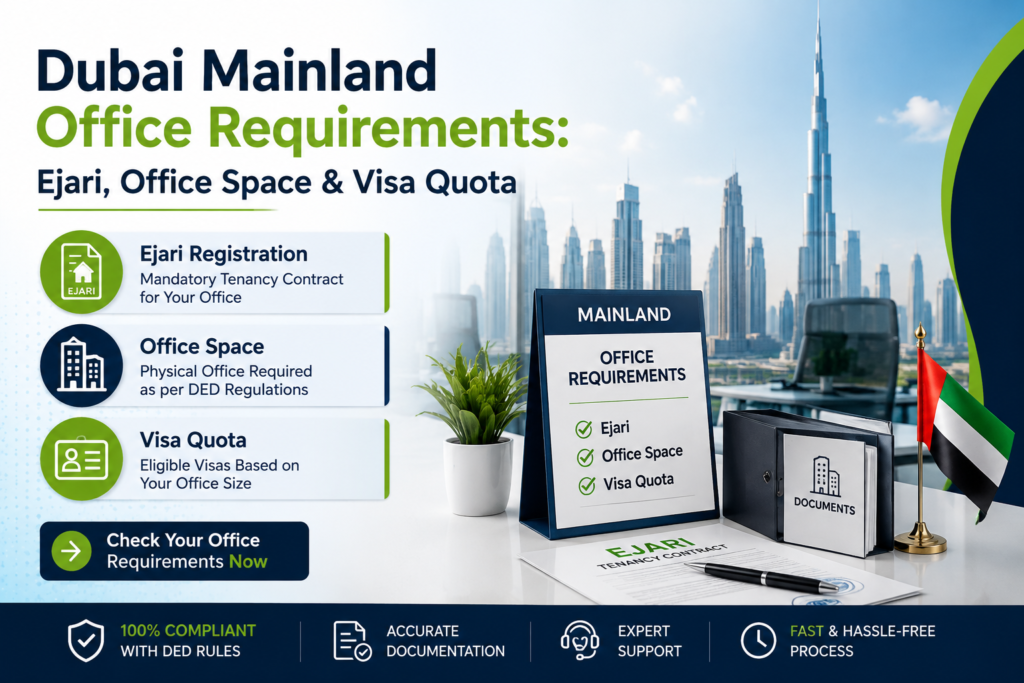
The UAE government states that businesses must have a physical address and that business premises must comply with the requirements of the relevant emirate and local planning authorities. In Dubai, the tenancy agreement must be registered with Ejari.
Your premises requirements can vary significantly.
May require a relatively straightforward office arrangement depending on the activity.
May need customer-facing premises.
May require additional location and municipality approvals.
May require industrial premises and additional regulatory approvals.
May require office and potentially warehouse arrangements depending on its activities.
This is why you should confirm your premises requirements before signing a long-term lease.
Not every business requires additional approvals.
But regulated or specialised activities may need approval from another government authority.
The UAE government’s mainland guidance gives examples involving:
and other regulated areas.
Suppose you select an activity that requires approval from another authority.
You cannot simply assume:
Trade name → licence
Instead, the process may involve:
Activity → Initial approval → External approval → Final licence
The additional approval can affect:
Therefore, identify regulated activities early.
Once the required approvals and premises arrangements are ready, prepare the final licensing documentation.
Depending on your company, this can include:
The exact document list varies according to the business and legal form.
The UAE government’s current guidance lists the initial approval documents, lease contract, MOA where applicable and other required government approvals among the documentation used for licence issuance.
Once your documents are complete, you will need to pay the applicable fees.
Your total setup cost can include:
The UAE government notes that the licence payment voucher must be paid within the specified period, with the current guidance stating 30 days; failure to pay within the required period can result in cancellation of the application.
Don’t compare business setup providers based only on the advertised licence fee.
Compare the total first-year cost.
For a detailed breakdown, see:
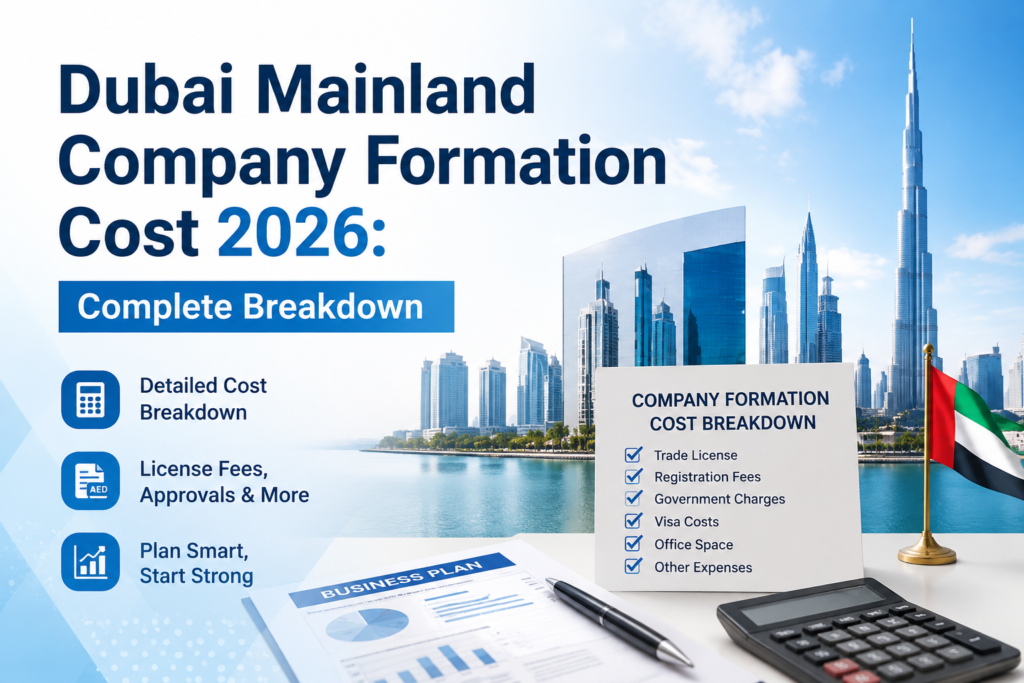
Dubai Mainland Company Formation Cost 2026
Once the required steps, documents, approvals and payments are completed, the business licence can be issued through the applicable Dubai economic authority channels.
At this point, your company has completed the core business licensing process.
But your setup may not be finished.
If you need:
there are additional steps.
This distinction is important:
is not necessarily the same as
If you need UAE residency or employees, additional immigration procedures follow company formation.
For employees, the UAE government explains that employers need to establish the relevant files and obtain the necessary establishment card and electronic signature arrangements before applying for work permits. The process then involves residency, medical fitness and Emirates ID procedures.
Employee onboarding can therefore involve:
The government also provides the Work Bundle platform to streamline several employment and residency procedures.
If you are the owner and want UAE residency through your company, the applicable investor/residence process should be handled separately from the basic trade licence process.
Company formation and bank account opening are two different processes.
After receiving the licence, you can approach a suitable UAE bank for a corporate account.
Banks can independently assess:
Therefore:
Having a Dubai mainland licence does not guarantee approval for a particular corporate bank account.
Prepare a strong banking file containing, where applicable:
The exact requirements vary between banks.
There is no single timeline that applies to every business.
A straightforward setup can move relatively quickly when:
The process can take longer when you have:
Company formation timeline
→ obtaining the business licence
Residency timeline
→ investor/employee visa and Emirates ID
Banking timeline
→ corporate bank account approval
They are separate processes.
This distinction makes your business planning much more realistic.
Step | What Happens |
1 | Choose business activity |
2 | Select legal structure |
3 | Choose trade name |
4 | Obtain initial approval |
5 | Prepare MOA/required agreements |
6 | Arrange business premises |
7 | Obtain additional approvals if required |
8 | Submit final documents |
9 | Pay applicable fees |
10 | Receive mainland business licence |
11 | Complete immigration/employee requirements |
12 | Apply for corporate bank account |
This sequence is a practical representation of the official mainland formation process, with post-licensing activities separated from the core licence issuance steps.
The exact requirements depend on your company.
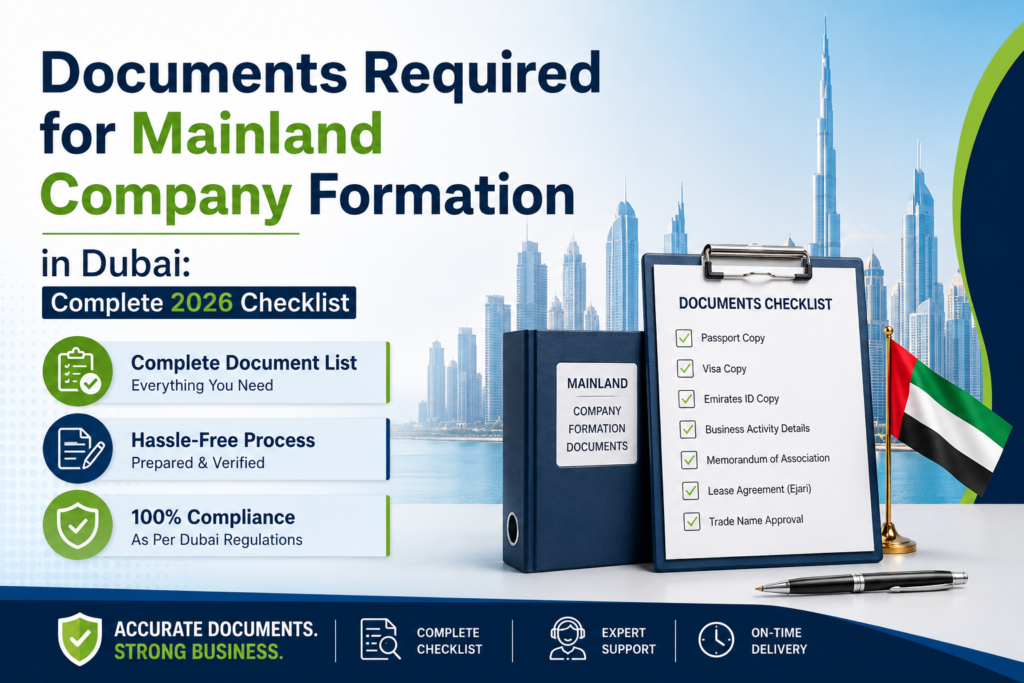
However, you may need:
If another company owns shares, additional documents may be required, such as:
International documents may require additional authentication or attestation.
The cost depends on the business.
Your budget can include:
A basic professional-services setup can have a significantly different cost from a trading company with employees or a regulated business.
For the detailed cost breakdown, read:
Dubai Mainland Company Formation Cost 2026: Fees, Visa & More
In many cases, yes.
The UAE’s current framework allows 100% foreign ownership for many mainland commercial activities, although strategic sectors and certain restricted activities can have additional requirements or ownership restrictions. The UAE government specifically notes exceptions including areas such as security and defence, telecommunications, banking, financing, insurance and certain other strategic activities.
Therefore, don’t rely on a blanket statement such as:
“All Dubai mainland companies can be 100% foreign-owned.”
The correct approach is:
Check ownership eligibility for the specific business activity.
The traditional idea that every foreign-owned mainland company requires a 51% Emirati shareholder is no longer accurate for most mainland commercial activities.
The UAE’s current framework permits 100% foreign ownership for many activities.
However, certain strategic or restricted activities can have specific requirements.
This is why the business activity should be checked before incorporation.
For a deeper explanation, see our future guide on:
100% Foreign Ownership in Dubai Mainland: Rules & Restrictions
Your business activity should come first.
A low advertised licence price may exclude office, visa, approvals or other mandatory costs.
Confirm the premises requirements before committing.
Initial approval allows you to proceed with the setup; it does not itself authorise you to conduct the business activity.
Regulated activities may require approval from other authorities.
Bank approval is a separate process.
Your licence may be issued before the entire residency process is complete.
Your first-year setup budget is not the same as your annual operating budget.
You can reduce unnecessary delays by preparing before starting the application.
Know exactly what your company will do.
Keep passports and corporate documents ready.
Have alternative names available in case your first choice is unavailable.
Check whether your activity is regulated.
Understand premises requirements before signing a lease.
Know how many investor and employee visas you actually need.
Prepare a proper business profile for your bank application.
Receiving the business licence is a major milestone, but operating the business involves additional responsibilities.
Depending on the company, these may include:
The UAE government’s guidance on running a mainland business covers areas including banking, WPS, health insurance, foreign trade and other operational requirements.
So your planning should not stop at:
“How do I get the licence?”
It should continue to:
“How do I operate the company compliantly?”
Before incorporating, compare mainland with the alternatives.
Mainland may be attractive if you:
A free zone may be more appropriate for certain businesses with different operational requirements.
The UAE government notes that free-zone access to the mainland market is subject to applicable rules and licensing arrangements.
Don’t choose mainland simply because someone tells you it is “better.”
Choose it because it fits your business model.
Before submitting your application, confirm:
The process generally starts by selecting the business activity and legal structure, followed by trade name registration, initial approval, required agreements, premises, additional approvals where applicable, document submission and payment of the applicable fees.
The first step is to identify your intended business activity. The UAE government states that the activity forms the basis for selecting the licence and legal form.
There is no universal timeline. Straightforward applications can progress faster than businesses requiring external approvals, complex documentation, specialised premises or additional regulatory processes.
Many aspects of business setup can be initiated through online government channels, but requirements depend on the applicant, activity, legal form and documentation. The UAE government provides digital services for mainland business establishment.
Businesses must satisfy applicable physical-address requirements, and Dubai tenancy agreements are registered through Ejari. The exact premises requirements depend on the business activity and applicable rules.
Not necessarily. Many mainland activities allow 100% foreign ownership under the current UAE framework, although strategic and restricted activities can have additional requirements.
Potentially, yes. The UAE government's mainland guidance states that a business can have more than one activity, subject to applicable requirements.
Not necessarily. Some activities require additional approvals, and businesses may also need to complete premises, immigration, employment and other regulatory requirements before operating in specific circumstances.
No. Company incorporation and corporate banking are separate processes. Banks conduct their own assessment and may request additional documents.
There is no universal cost. Your budget depends on the activity, legal structure, licence, office, visas, approvals and other requirements. See our Dubai Mainland Company Formation Cost 2026 guide for a detailed breakdown.
Setting up a mainland company in Dubai is not simply a matter of buying a trade licence.
The process starts with your business activity and then moves through the appropriate legal structure, trade name, initial approval, documentation, premises, additional approvals and final licence issuance.
The basic journey is:
Business Activity
↓
Legal Structure
↓
Trade Name
↓
Initial Approval
↓
MOA / Required Agreements
↓
Business Premises
↓
Additional Approvals
↓
Final Documents
↓
Government Fees
↓
Mainland Business Licence
↓
Visa / Employee Setup
↓
Banking & Compliance
Each business is different, so the most efficient approach is to determine your requirements before applying rather than trying to fit your business into a pre-defined package.
If you’re ready to establish a company in Dubai mainland, explore Ofin Global’s Mainland Company Formation service and get guidance based on your business activity, ownership and setup requirements.
Discover licensing requirements, setup costs, required documents, approvals, and expert tips to start your grocery business successfully.
Apply NowOur expert will contact you within 24 hours!

UAE:
Happyhearts Corporate Services FZCO, DSO-IFZA, IFZA Properties,
Dubai Silicon Oasis
Mob: +971 50 523 5779
Email: support@ofinglobal.com
India:
Address: C – 3, Shanti Bhuvan, Dr Rajendra Prasad Rd, Mulund West, Mumbai 400080
Mob: +91 9410 247 247
