
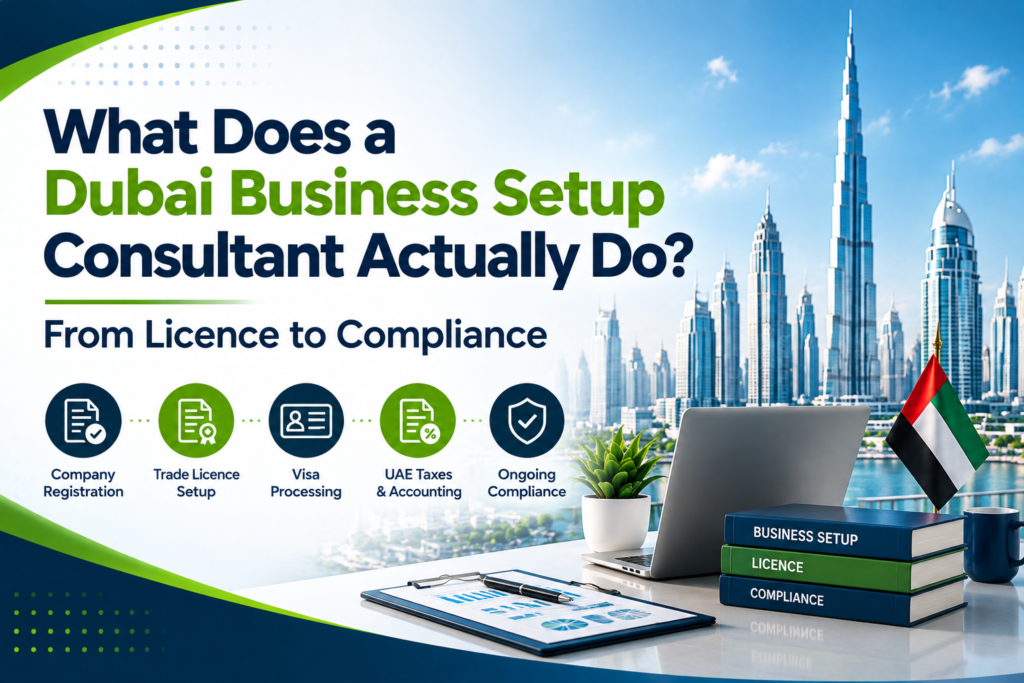
Starting a company in Dubai involves more than obtaining a trade licence.
You may need to decide on your business activity, jurisdiction, legal structure, visas, office requirements, banking and ongoing compliance before the company can operate effectively.
That is where a business setup consultant can add value.
A good consultant does more than submit forms.
They should help you determine which structure fits your business, what it will actually cost, what approvals may be required, and what happens after incorporation.
This guide explains what a Dubai business setup consultant actually does, what you should expect from the service,
what to ask before hiring one, and how to recognise whether you’re receiving genuine advisory value or simply being sold a licence package.
The role generally covers two areas:
Advisory: helping you make the right decisions before incorporation.
Implementation: coordinating the licensing, documentation and government procedures needed to establish the company.
Depending on your requirements, this can include:
The exact scope varies between providers, so always request the services and fees in writing.
A consultant should start by understanding how your business operates.
Typical questions include:
These answers influence almost every decision that follows.
A consultant who recommends a package before understanding your business model is primarily selling a product, not providing tailored advice.
Your licence should reflect what your company actually does.
A consultant can help determine:
Don’t select an activity simply because it sounds close to your business or appears cheaper.
Ask:
“Why does this activity match my actual business model?”
The consultant should be able to explain the recommendation clearly.
A consultant should explain the reasoning behind a jurisdiction recommendation rather than simply presenting the cheapest package.
The comparison may involve:
The right question is therefore not:
“Which option is cheapest?”
It is:
“Which structure makes sense for how my business will operate?”
If you’re comparing free zones, link to your existing How to Choose the Right Free Zone in Dubai guide here.
Your consultant should explain the legal structures available for your circumstances and why one may be more suitable than another.
The recommendation can depend on:
Don’t assume the structure included in a standard package is automatically appropriate for your business.
One of the biggest mistakes entrepreneurs make is comparing consultants using only the advertised package price.
Your actual cost may involve:
Cost area | What to clarify |
Licence & government fees | What is mandatory? |
Immigration/establishment | Is it included? |
Visas | How many are required? |
Office/workspace | Is one required? |
Additional approvals | Does the activity need them? |
Professional fees | What does the consultant charge? |
Accounting & tax | Included or separate? |
Renewal | What will recur annually? |
Ask for two figures:
Total setup/first-year cost
and
Expected recurring annual cost
Also ask:
“What isn’t included in this quotation?”
For a detailed breakdown of mainland costs, link to your existing Dubai Mainland Company Formation Cost guide.
Once the structure is established, the consultant may coordinate the practical incorporation process.
This can include:
Documentation requirements can vary according to the shareholder, nationality, legal structure, jurisdiction and business activity.
The consultant’s role is to identify the applicable requirements and coordinate the process rather than simply hand you a generic document list.
Company formation and immigration are related but separate processes.
Depending on the setup, a consultant may assist with:
Visa availability and requirements can depend on the jurisdiction, office arrangement and company structure.
Before accepting a package, ask:
“How many visas does this setup support, and what additional costs apply?”
Corporate banking is often one of the areas where preparation matters most.
A consultant may help you understand and prepare:
But there is an important distinction between bank introduction and application preparation.
A consultant should not guarantee bank approval. Banks conduct their own due diligence and make independent decisions.
The useful question to ask is:
“What exactly do you do to prepare and support my bank account application?”
Getting the licence is not the end of the process.
Depending on the business and applicable rules, ongoing obligations can include:
These requirements should be discussed during setup so you understand the responsibilities you’ll have once the company starts operating.
For ongoing financial support, link to Accounting Services in Dubai.
For relevant audit and compliance support, link to Auditing Services in Dubai.
A consultant’s involvement may continue beyond company formation.
Depending on the provider, post-setup services can include:
This is worth discussing before you hire the consultant.
Your business may start with one activity and a small team, then require additional employees, activities or services later. A consultant who understands your longer-term plans can help you plan for those changes.
The difference between a useful consultant and a licence seller usually becomes obvious from the questions they ask and the explanations they provide.
Why this activity?
They understand what your business actually does.
Why this jurisdiction?
They can explain the relevant trade-offs rather than simply promoting the cheapest package.
What will it really cost?
They distinguish government fees, professional fees, optional services and recurring costs.
What happens after incorporation?
They explain visas, banking, accounting, tax and renewal requirements where relevant.
What depends on third parties?
They don’t present bank or government decisions as guaranteed outcomes.
A low price isn’t necessarily a bad sign. A low price with unclear scope is.
Instead of asking dozens of generic questions, focus on these:
The quality of the answers is often more informative than the number of services listed on a website.
If you’re comparing several providers, score each one consistently rather than choosing based on price alone.
Evaluation factor | Weight |
Understanding of your business activity | 20 |
Mainland/free-zone expertise | 15 |
Pricing transparency | 15 |
Banking assistance | 10 |
Visa support | 10 |
Tax knowledge | 10 |
Accounting/compliance support | 10 |
Post-setup support | 5 |
Communication | 5 |
Total | 100 |
80–100: Strong candidate; verify the final scope and quotation.
60–79: Potentially suitable; investigate weaker areas.
Below 60: Proceed carefully and ask additional questions.
This is a practical comparison framework, not an official industry rating.
Not necessarily.
A straightforward business owner who already understands the licensing process, knows the preferred jurisdiction and has time to manage the administration may be comfortable handling the setup independently.
Professional guidance can become more valuable when the setup involves:
The decision ultimately comes down to complexity, time, risk and the cost of getting an important decision wrong.
OfinGlobal approaches company formation as a business-structuring process rather than simply a licence purchase.
The process can be summarized as:
Understand → Map → Compare → Calculate → Prepare → Incorporate → Support
Review the business model, ownership, customers, operating requirements and growth plans.
Identify relevant business activities and licensing requirements.
Evaluate appropriate mainland and free-zone options based on the business.
Estimate setup costs, visas, office requirements and recurring obligations.
Coordinate documentation, approvals and incorporation requirements.
Proceed with the applicable company formation and licensing process.
Assist with relevant banking, visas, accounting, tax, renewals and compliance after incorporation.
The objective is to establish a structure that fits the business today while avoiding unnecessary complications as it grows.
A business setup consultant can assist with activity selection, jurisdiction evaluation, company formation, licensing, documentation, visas, banking assistance, accounting, tax and ongoing compliance. The exact scope depends on the provider and your requirements.
Not necessarily. A company formation agent may focus primarily on incorporation and licensing, while a broader business setup consultant may also advise on structure, jurisdiction, costs, banking, tax and post-setup requirements.
A consultant can evaluate free zones based on your business activity, ownership, customers, visas, office requirements, budget and growth plans. There is no single free zone that is appropriate for every business.
No. Banks independently assess applications and conduct their own due diligence. A consultant can assist with preparation and coordination but cannot legitimately guarantee approval.
Yes. Straightforward businesses may be able to handle the process themselves. Professional support becomes more useful as the structure, activities, ownership, visas or compliance requirements become more complex.
Not automatically. Accounting, Corporate Tax and VAT services may be separate. Confirm exactly what is included in your package and what support is available after incorporation.
Look for a consultant who understands your business activity, explains why a particular structure is appropriate, provides transparent pricing, understands banking and visa requirements, addresses compliance and offers appropriate post-setup support.
A business setup consultant should do more than obtain a trade licence.
Their real value lies in helping you make informed decisions before incorporation, coordinating the setup correctly, preparing you for banking and immigration requirements, and explaining what compliance looks like after the company is established.
Before hiring one, look beyond the package price.
Evaluate:
Most importantly, ask:
“Why is this setup right for my business?”
If the consultant can give you a clear answer based on your actual business model—not simply a package they sell—you are in a much better position to make an informed decision.
Ofin Global is a UAE business setup and compliance consultancy helping entrepreneurs establish and manage businesses in Dubai and across the UAE.
Our approach goes beyond obtaining a trade licence—we help clients evaluate business activities, compare suitable jurisdictions, understand setup and recurring costs, prepare for banking and visa requirements, and plan for ongoing tax,
accounting and compliance obligations. With support across company formation, banking assistance, visas, accounting, tax advisory and post-setup compliance,
OfinGlobal aims to provide businesses with a practical structure that supports both their immediate needs and long-term growth.
Learn what a Dubai business setup consultant actually does, from business activity and jurisdiction selection to licensing, visas, banking, tax and ongoing compliance.
Book a Free ConsultationOur expert will contact you within 24 hours!

UAE:
Happyhearts Corporate Services FZCO, DSO-IFZA, IFZA Properties,
Dubai Silicon Oasis
Mob: +971 50 523 5779
Email: support@ofinglobal.com
India:
Address: C – 3, Shanti Bhuvan, Dr Rajendra Prasad Rd, Mulund West, Mumbai 400080
Mob: +91 9410 247 247
