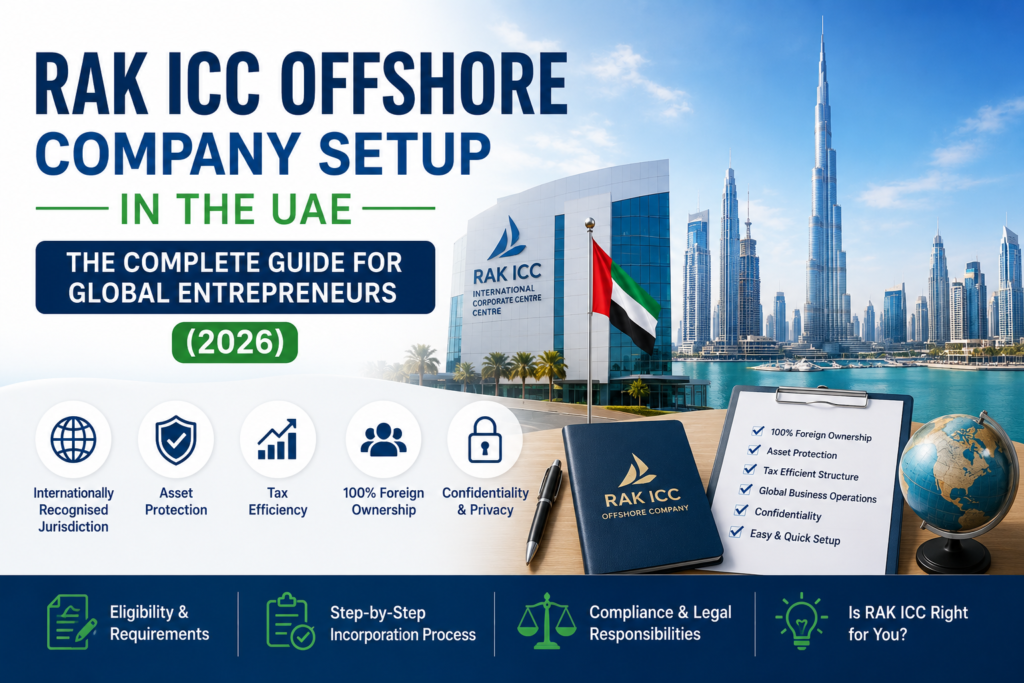
Setting up an offshore company isn’t just about reducing costs or simplifying business operations—it’s about choosing the right legal structure that aligns with your long-term business goals. Whether you’re an entrepreneur expanding internationally, an investor protecting assets, or a business owner looking to hold overseas investments, selecting the right jurisdiction is one of the most important decisions you’ll make.
Among the many offshore jurisdictions available worldwide, RAK International Corporate Centre (RAK ICC) has become one of the UAE’s most respected and internationally recognised offshore company registries. It offers a flexible corporate structure, a business-friendly regulatory environment, and access to one of the world’s leading financial and commercial hubs.
However, despite its growing popularity, many entrepreneurs misunderstand what a RAK ICC company can and cannot do. Some assume it works like a UAE Free Zone company, while others believe it automatically provides residence visas or allows businesses to trade directly within the UAE. These misconceptions often lead investors to choose the wrong business structure, resulting in unnecessary costs, delays, and operational challenges.
This guide has been created to help you make an informed decision. Instead of simply explaining the registration process, we’ll answer the questions that matter most before you invest your time and money.
By the end of this guide, you’ll understand:
Whether you’re a first-time entrepreneur or an experienced international investor, this guide will help you determine whether RAK ICC is the right foundation for your business strategy.
A RAK ICC Offshore Company is an international business company incorporated through the RAK International Corporate Centre, one of the UAE’s leading corporate registries. It is designed primarily for businesses and investors conducting activities outside the UAE, such as international trading, holding investments, owning intellectual property, or managing global assets.
Unlike a mainland or free zone company, a RAK ICC company is not intended for carrying out commercial activities within the UAE domestic market. Instead, it provides a recognised corporate vehicle for international business, cross-border investments, and wealth structuring, subject to applicable UAE laws and regulatory requirements.
One of the reasons RAK ICC has become a preferred jurisdiction is its balance between credibility, flexibility, and ease of administration. Investors from around the world choose RAK ICC because it operates within a well-regulated environment while offering a straightforward incorporation process and modern corporate legislation.
It’s important to understand that “offshore” does not mean secretive or unregulated. Modern offshore companies are expected to comply with international transparency standards, maintain corporate records, and meet applicable reporting obligations. Choosing RAK ICC means operating within a recognised legal framework rather than avoiding regulation.
RAK International Corporate Centre was established to strengthen the UAE’s position as a global destination for international business and investment. As cross-border trade and international investment have grown, businesses increasingly require corporate structures that are flexible, internationally recognised, and suitable for managing global operations.
RAK ICC was created to meet this demand by providing a dedicated corporate registry for international companies. Today, it supports entrepreneurs, family offices, multinational groups, holding companies, and investors who require a corporate vehicle for legitimate international business activities.
Rather than focusing on local trading, RAK ICC enables businesses to structure international operations efficiently while benefiting from the UAE’s reputation as a stable and business-friendly jurisdiction.
Every business has different objectives, and there is no single corporate structure that suits everyone. However, RAK ICC continues to attract international entrepreneurs because it offers several strategic advantages for businesses operating across multiple countries.
Choosing the right jurisdiction is about more than completing a registration form. Investors, financial institutions, and international partners often consider where a company is incorporated when evaluating its credibility.
RAK ICC is recognised as part of the UAE’s well-established business environment, making it an attractive option for businesses seeking an internationally respected corporate structure.
Many entrepreneurs don’t need a company to trade within the UAE. Instead, they require a legal entity to hold overseas investments, manage intellectual property, own shares in other companies, or conduct international transactions.
RAK ICC provides a structure that supports these objectives while allowing businesses to operate internationally, subject to applicable laws and banking requirements.
A RAK ICC company is commonly used by investors who want to separate personal assets from business holdings.
Depending on the circumstances and legal requirements, a RAK ICC company may be used to hold:
This can make long-term ownership structures more organised and easier to manage.
The UAE has earned a strong global reputation for supporting entrepreneurship, attracting foreign investment, and maintaining a modern regulatory framework.
For many international investors, establishing a company within this environment provides confidence and stability when expanding into global markets.
Businesses operating across multiple countries often require a corporate structure that supports international transactions without being tied to a single domestic market.
RAK ICC can be an effective option for companies whose activities are primarily international rather than local.
This is the most important question—and one that many websites fail to answer.
A RAK ICC company is an excellent solution for some businesses, but it is not the right choice for everyone. Before deciding on this structure, consider what you want your business to achieve over the next five to ten years.
For these objectives, RAK ICC is often considered a practical and flexible solution.
In these situations, a UAE mainland or free zone company may be more appropriate, depending on your business activity and operational requirements.
Before moving forward, ask yourself these five questions:
 Yes → RAK ICC may be suitable.
Yes → Consider a mainland or free zone company instead.
Yes → RAK ICC is often well suited for this purpose.
Yes → RAK ICC is generally not the appropriate structure for local trading.
Yes → RAK ICC is commonly used for these objectives.
If you answered “Yes” to most of the first, third, and fifth questions, and “No” to the second and fourth, a RAK ICC company may align well with your business goals.
The next step is understanding exactly what benefits a RAK ICC company offers, its limitations, who can establish one, and the legal and compliance obligations that come with ownership. Making an informed decision now can save significant time, cost, and restructuring later.
Choosing a business structure is rarely about finding the cheapest option. Most international entrepreneurs are looking for a company structure that supports growth, protects assets, simplifies ownership, and provides long-term flexibility.
This is where RAK ICC stands out.
While every business should evaluate its specific requirements before incorporation, there are several reasons why international investors continue to choose RAK ICC as their preferred offshore jurisdiction.
One of the biggest advantages of a RAK ICC company is that foreign investors can own the company entirely.
Unlike jurisdictions that require local partners or shareholders, RAK ICC allows international entrepreneurs to maintain full ownership and control of their business structure.
For investors managing global assets or international operations, this provides greater flexibility and decision-making authority.
Many investors establish RAK ICC companies not because they need an operating business, but because they need a legal structure to hold valuable assets.
Depending on the purpose and applicable regulations, a RAK ICC company may be used to hold:
By separating personal and business ownership, investors can create a more organised ownership structure and improve long-term succession planning.
Businesses operating across multiple countries often require a corporate vehicle that is not tied to a single domestic market.
A RAK ICC company can provide flexibility for entrepreneurs conducting international activities, including:
This makes it particularly attractive to digital entrepreneurs, consultants, investors, and multinational groups.
Many entrepreneurs choose RAK ICC because it offers a relatively straightforward incorporation process and manageable ongoing administration when compared with certain international jurisdictions.
This allows investors to focus more on growing their business and less on unnecessary administrative complexity.
The UAE has established itself as one of the world’s leading business destinations.
For international entrepreneurs, incorporating within a recognised jurisdiction can strengthen business credibility when dealing with:
The jurisdiction in which a company is incorporated often plays an important role in how that business is perceived globally.
One of the most common mistakes investors make is assuming that a RAK ICC company functions like a mainland or free zone business.
It doesn’t.
RAK ICC is primarily designed for international business activities rather than local UAE operations.
Understanding what a RAK ICC company can do helps prevent costly mistakes later.
A RAK ICC company is frequently used for:
Many investors use RAK ICC companies to own shares in:
Holding structures are among the most common uses of RAK ICC companies.
Investors often use RAK ICC entities to manage and hold international investment portfolios under a dedicated corporate structure.
This can simplify ownership and centralise management of multiple investments.
Businesses that own valuable intellectual property may choose to hold those assets through a separate legal entity.
Examples include:
Where activities are conducted internationally and comply with applicable laws and regulations, RAK ICC may form part of a broader international business structure.
Many family offices and investors use offshore structures for long-term asset management and succession planning purposes.
This is equally important.
A large percentage of offshore company issues arise because investors assume the company can perform activities that are actually outside its intended purpose.
A RAK ICC company is not designed for conducting regular commercial activities within the UAE domestic market.
Businesses intending to sell products or services directly in the UAE should generally consider mainland or free zone structures.
If you plan to open:
RAK ICC is unlikely to be the appropriate structure.
One of the most common misconceptions is that every UAE company automatically qualifies for residence visas.
RAK ICC companies generally do not serve the same purpose as free zone or mainland entities that are specifically structured for visa sponsorship.
Entrepreneurs seeking UAE residency should evaluate alternative business structures.
Businesses requiring:
should usually consider a mainland or free zone company rather than an offshore structure.
|
A RAK ICC Company Can |
A RAK ICC Company Cannot |
|
Hold investments |
Operate a local retail business |
|
Own shares in companies |
Trade directly in the UAE market |
|
Hold intellectual property |
Sponsor operational staff in the same way as mainland/free zone entities |
|
Act as a holding company |
Conduct activities requiring a UAE commercial licence |
|
Support international business structures |
Operate local service businesses |
This simple distinction helps investors determine whether RAK ICC aligns with their goals before spending money on incorporation.
One reason for the popularity of RAK ICC is its accessibility to international investors.
Entrepreneurs from around the world choose RAK ICC because ownership is not limited to UAE nationals.
A RAK ICC company can generally be owned by individual shareholders from various countries, subject to applicable regulatory and compliance requirements.
This makes it attractive to:
Businesses can also use corporate entities as shareholders.
This is particularly useful when:
A company may also be structured with multiple shareholders depending on the investor’s requirements.
This provides flexibility for:
Before incorporation, it’s important to understand the key roles within a RAK ICC company.
Shareholders are the owners of the company.
Their responsibilities generally include:
Shareholders may be individuals or corporate entities.
Directors are responsible for managing the company and overseeing corporate activities.
Their duties may include:
Choosing experienced and reliable directors is important because they play a central role in managing the company responsibly.
Certain corporate structures may require or appoint a secretary to assist with:
The exact requirements depend on the company’s structure and applicable regulations.
The answer depends on the startup’s business model.
A technology startup serving international customers and holding intellectual property may find RAK ICC useful as part of its overall corporate structure.
However, a startup that requires:
may be better suited to a mainland or free zone company.
This is why business objectives should always be evaluated before selecting a structure.
The right company isn’t necessarily the cheapest or fastest to establish—it’s the one that supports your long-term growth strategy.
In the next section, we’ll cover the practical side of incorporation, including eligibility requirements, documents needed, step-by-step registration, banking considerations, real estate ownership, compliance obligations, and common mistakes investors should avoid before setting up a RAK ICC offshore company.
Choosing the right business structure isn’t just about completing a company registration—it’s about selecting a legal entity that supports your business strategy today and as it grows in the future.
For many international entrepreneurs, RAK ICC offers an efficient way to structure overseas business activities, hold investments, and manage assets through a UAE-based corporate entity. However, its advantages are most valuable when the company is used for the purposes it was designed for.
Let’s explore the key benefits and what they mean in practice.
One of the biggest reasons international investors choose RAK ICC is that the company can be wholly owned by foreign individuals or corporate shareholders.
There is no requirement for a local Emirati shareholder, allowing investors to retain full ownership and control over their business structure.
This is particularly beneficial for entrepreneurs who want to centralise ownership of international investments without introducing additional shareholders.
Reputation matters in international business.
RAK ICC is one of the UAE’s established international corporate registries, making it a respected jurisdiction for investors, financial institutions, and multinational businesses.
For entrepreneurs working with overseas suppliers, investors, or professional service providers, operating through a recognised UAE corporate structure can enhance credibility.
One of the most common uses of a RAK ICC company is as a holding company.
Instead of owning investments personally, many investors choose to hold them through a separate corporate entity.
For example, a RAK ICC company may be used to hold:
Using a holding company can also make ownership easier to manage when businesses expand or new investors are introduced.
If your customers, suppliers, or investments are located outside the UAE, RAK ICC provides a flexible legal structure for managing international operations.
This makes it particularly attractive for:
Rather than focusing on local trading, the company is designed for cross-border business activities.
Many entrepreneurs start by conducting business in their own name.
As their business grows, this approach can create unnecessary risks.
Using a separate corporate entity allows business assets to be managed independently from personal assets, providing a clearer ownership structure and supporting better corporate governance.
Businesses operating in multiple countries often require a single corporate vehicle that can own subsidiaries, investments, or intellectual property.
Instead of creating multiple ownership structures, many entrepreneurs use a RAK ICC company as the parent holding company for their international operations.
This approach can simplify long-term business planning and future expansion.
Compared to many international jurisdictions, establishing and maintaining a RAK ICC company is generally straightforward.
While ongoing compliance requirements still apply, the corporate structure is designed to be practical for international investors managing cross-border businesses.
This makes it attractive to entrepreneurs who prefer an efficient corporate framework without unnecessary complexity.
Understanding what a RAK ICC company is designed for is just as important as understanding how to register one.
Many investors assume offshore companies can be used for every type of business activity.
In reality, RAK ICC companies are intended primarily for international business and investment activities.
Common uses include:
A RAK ICC company can be used to own shares in local or international businesses, making it an effective holding structure for entrepreneurs with multiple investments.
Businesses may use a RAK ICC company to hold intellectual property such as:
This can simplify ownership and licensing arrangements where appropriate.
Many investors establish RAK ICC companies to hold:
Businesses engaged in international trade between countries outside the UAE may find RAK ICC an appropriate corporate structure, depending on the nature of their operations and applicable regulations.
Family offices and high-net-worth individuals often use holding companies to organise investments and facilitate long-term succession planning.
A RAK ICC company can form part of a broader wealth management strategy when combined with appropriate legal and tax advice.
This is one of the most misunderstood aspects of offshore companies.
Many entrepreneurs establish an offshore company only to discover later that it doesn’t support their intended business activities.
Before proceeding, understand these important limitations.
If your goal is to sell products or services directly to customers in the UAE domestic market, a RAK ICC company is generally not the appropriate structure.
Businesses intending to operate locally should consider a mainland or eligible free zone company instead.
Unlike many free zone companies, a RAK ICC company is generally not established for obtaining UAE residence visas.
If relocating to the UAE is one of your priorities, another business structure may better suit your objectives.
Businesses such as:
typically require a mainland or free zone licence rather than an offshore company.
Each UAE company type has a different purpose.
Choosing RAK ICC simply because it appears less expensive may create operational challenges if your business actually requires local trading rights or employee visas.
Selecting the right structure from the beginning often saves significant time and restructuring costs later.
RAK ICC is designed for international investors and businesses seeking a recognised UAE corporate structure.
Depending on the applicable regulations, eligible applicants may include:
One of its strengths is that it accommodates a wide range of ownership structures, making it suitable for both individual investors and multinational organisations.
Before registering a RAK ICC company, it’s helpful to understand the key roles involved.
The shareholders are the legal owners of the company.
They may be:
Their responsibilities generally include major business decisions, ownership transfers, and strategic direction.
Directors are responsible for managing the affairs of the company and ensuring it operates in accordance with applicable laws and its constitutional documents.
Depending on the company’s structure, there may be one or more directors.
Choosing experienced directors is important because they play a key role in governance and decision-making.
Some corporate structures appoint a company secretary to assist with maintaining corporate records, preparing resolutions, and supporting ongoing administrative compliance.
The specific requirements depend on the company’s structure and applicable regulations.
Many entrepreneurs begin by asking:
“How quickly can I register my company?”
A better question is:
“Will this company structure still meet my business needs five years from now?”
If your objective is international expansion, investment holding, or protecting valuable business assets, RAK ICC can provide a strong foundation.
However, if your plans include hiring employees, opening a local office, trading directly within the UAE, or obtaining residence visas, another business structure may offer greater flexibility.
Making the right decision at the beginning is often far more valuable than completing the registration quickly.
Once you’ve decided that a RAK ICC offshore company is the right structure for your business, the next step is preparing the required documentation. Having the correct documents ready from the beginning helps avoid delays during the incorporation process and ensures that the registered agent can complete the necessary due diligence efficiently.
Although the exact requirements may vary depending on the shareholder’s nationality, whether the shareholder is an individual or a corporate entity, and the nature of the proposed business, most applications require a standard set of identification and corporate documents.
If you’re registering a RAK ICC company as an individual investor, you will typically be asked to provide:
|
Document |
Purpose |
|
Passport Copy |
Confirms the identity and nationality of the shareholder. |
|
Proof of Residential Address |
Verifies your current residential address. Utility bills or bank statements are commonly accepted if they meet the applicable requirements. |
|
Bank Reference Letter (where required) |
Helps establish your banking relationship and financial credibility. |
|
Professional or Business Profile |
Provides background on your business experience and intended activities. |
|
Source of Funds Information |
Demonstrates the legitimate origin of the funds being invested. |
Providing clear, up-to-date, and readable documents can significantly reduce the time required for document verification.
If another company will own shares in the RAK ICC entity, additional corporate documents are generally required, such as:
These documents help verify the ownership structure and ensure compliance with applicable corporate transparency requirements.
Many first-time investors wonder why so much documentation is required.
The answer is simple: the UAE follows international compliance and anti-money laundering (AML) standards. Registered agents and authorities must verify the identity of company owners, understand the intended business activities, and conduct appropriate due diligence before incorporation.
Rather than seeing these requirements as obstacles, it’s helpful to view them as part of maintaining the UAE’s reputation as a trusted international business jurisdiction.
Small mistakes can delay the registration process. Before submitting your application:
Preparing your documents carefully from the outset can help make the incorporation process much smoother.
Many entrepreneurs assume that setting up an offshore company is complicated. In reality, the process is straightforward when handled correctly and supported by complete documentation.
Below is an overview of the typical incorporation journey.
Before starting the application, clarify your objectives.
Ask yourself:
Choosing the correct business structure at the beginning can save significant time and expense later.
RAK ICC companies are incorporated through authorised registered agents.
A professional adviser can help you:
Seeking advice early can help prevent avoidable delays.
Selecting a company name is more than a branding exercise.
Your proposed name should comply with the applicable naming requirements and avoid restricted or misleading terms.
Many businesses prepare two or three alternative names in case their preferred option is unavailable.
During the incorporation process, you’ll need to describe the intended purpose of the company.
Examples may include:
Providing a clear business purpose helps ensure the company structure aligns with your objectives.
Your registered agent will review the required identification and supporting documents before submitting the incorporation application.
If additional information is required, responding promptly can help keep the process moving efficiently.
Once the application has been reviewed and approved, the company is incorporated and the relevant corporate documents are issued.
These documents are important and should be stored securely, as they may be required for banking, compliance, and future corporate transactions.
Many investors assume the process ends once the company is registered.
In reality, incorporation is only the beginning.
After registration, you may need to consider:
Planning for these responsibilities from the beginning can help your company remain compliant and operate efficiently.
One of the most common questions investors ask is:
“How quickly can my company be incorporated?”
The answer depends on several factors, including the completeness of your documents, the complexity of the ownership structure, and the time required for due diligence and approvals.
Straightforward applications with complete documentation are generally processed more efficiently than applications requiring additional clarification or supporting information.
Instead of focusing only on speed, prioritise accuracy. A well-prepared application is less likely to experience delays than one submitted with missing documents or inconsistent information.
Remember, incorporation is only one part of the journey. Opening a corporate bank account, implementing compliance procedures, and planning ongoing administration are equally important steps after registration.
One of the first questions investors ask is, “How much does a RAK ICC offshore company cost?” While it’s a valid question, the answer isn’t always straightforward.
Unlike buying a product with a fixed price, the total cost of incorporating a RAK ICC company depends on several factors, including your ownership structure, the services you require, and any post-incorporation support such as banking assistance or document attestation.
Rather than focusing only on the initial registration fee, it’s important to understand the overall investment involved in establishing and maintaining your company.
The total cost may vary depending on:
If your ownership structure is straightforward and your documents are complete, the process is generally simpler than for companies with multiple corporate shareholders or cross-border ownership arrangements.
It’s natural to compare prices from different service providers, but choosing solely based on cost can lead to unexpected issues later.
When evaluating providers, consider questions such as:
A transparent service provider will explain what is included in the quoted fee and highlight any additional costs that may arise, helping you avoid surprises later.
A common misconception is that incorporating a company automatically results in a corporate bank account.
In reality, company incorporation and bank account approval are two separate processes.
A RAK ICC company may apply for a UAE corporate bank account, but the decision to open an account rests entirely with the bank. Financial institutions conduct their own due diligence and assess each application based on their internal compliance policies.
Although requirements vary between banks, they commonly assess:
Providing complete and accurate information helps banks understand your business and may contribute to a smoother account opening process.
While no one can guarantee bank account approval, you can strengthen your application by:
Planning your banking strategy before incorporating your company is often a smarter approach than treating it as an afterthought.
Incorporating a RAK ICC company is only the first step. Like any corporate entity, it has ongoing responsibilities that should be managed carefully to maintain good standing.
Many first-time investors mistakenly believe that an offshore company requires no ongoing administration. In reality, maintaining compliance is an essential part of responsible company ownership.
RAK ICC companies are generally required to renew their registration each year.
Annual renewal typically involves:
Failing to renew on time can lead to additional costs, administrative complications, or changes to the company’s status.
Every company should maintain accurate corporate records, including:
Good record-keeping not only supports compliance but also simplifies future transactions, banking relationships, and audits where applicable.
Depending on the applicable legal framework, companies may have obligations relating to beneficial ownership reporting and other regulatory filings.
Because regulatory requirements can evolve, it’s important to stay informed and seek professional advice where necessary.
Although offshore companies are often associated with international business, owners should not assume that they are exempt from every tax or reporting obligation.
Your responsibilities may depend on:
Obtaining professional tax advice helps ensure that your company remains compliant with all applicable requirements.
One of the biggest mistakes investors make is comparing only the registration cost.
The better comparison is which structure best supports your long-term business objectives.
|
Feature |
RAK ICC |
JAFZA Offshore |
Free Zone Company |
Mainland Company |
|
Foreign Ownership |
100% |
100% |
100% (for most activities) |
100% for many activities, depending on the business |
|
Local UAE Trading |
No |
No |
Yes (subject to licensing rules) |
Yes |
|
UAE Residence Visa |
Generally No |
Generally No |
Yes |
Yes |
|
Physical Office |
Not typically required |
Not typically required |
Available |
Usually required depending on activity |
|
International Holding Company |
Excellent |
Good |
Good |
Possible |
|
Suitable for International Investment |
Yes |
Yes |
Yes |
Yes |
|
Best For |
Holding companies, asset ownership, international business |
Asset holding and international structuring |
Regional operations |
Businesses serving the UAE market |
Choose RAK ICC if your objective is:
Consider a Free Zone company if you need:
A Mainland company may be the better option if your primary customers are located within the UAE and you intend to operate directly in the local market.
The right choice depends on your business goals—not simply the cost of incorporation.