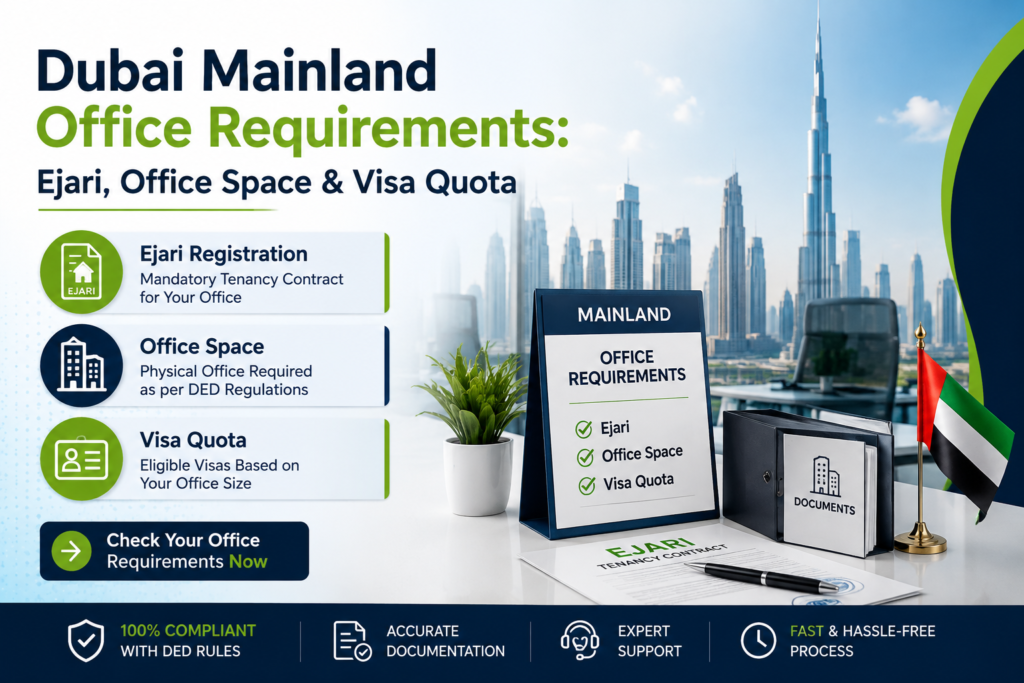
Setting up a mainland company in Dubai involves more than obtaining a trade licence.
For many businesses, you also need to arrange suitable business premises, register the tenancy through Ejari, and make sure the office is appropriate for your business activity and future staffing requirements.
One area that often creates confusion is visa quota. Business owners frequently hear that a particular office size automatically gives them a fixed number of visas. In reality, visa capacity should not be treated as a simple universal formula because requirements can depend on the company, activity, premises and applicable authority rules.
This guide explains what you need to know before renting an office for a Dubai mainland company.
What Office Requirements Do You Need for a Dubai Mainland Company?
For a typical mainland setup, you should consider:
- A suitable business premises
- A valid commercial tenancy arrangement
- Ejari registration where applicable
- Premises suitable for the licensed activity
- Sufficient space for your actual business requirements
- Compliance with applicable authority requirements
- Visa capacity appropriate for your staffing plans
The most important point is:
Don’t choose an office based only on rent or an assumed visa quota.
First confirm that the premises can support your business activity, licensing requirements and expected number of employees.
1. Is an Office Required for a Dubai Mainland Company?
For mainland businesses, a physical business address is an important part of the licensing process.
The exact premises requirements can vary according to the business activity and legal structure.
Some businesses may have relatively straightforward office requirements, while others may need premises that meet specific operational, municipal or sector requirements.
This is why you should determine your business activity before signing a long-term lease.
Don’t Make This Mistake
Many entrepreneurs start by searching for the cheapest office.
A better sequence is:
Business activity → Legal structure → Premises requirements → Office selection → Tenancy agreement / Ejari → Licence completion
This can prevent you from committing to premises that aren’t suitable for your intended business.
If you’re still deciding on the overall setup, you can first review Ofin Global’s Mainland Company Formation in Dubai guide.
2. What Is Ejari?
Ejari is Dubai’s system for registering tenancy contracts.
In simple terms:
Your tenancy agreement is the lease; Ejari is the official registration of that tenancy in Dubai’s system.
For a mainland business, this is particularly important because your business premises form part of the licensing and compliance framework.
3. Why Is Ejari Important for a Mainland Business?
Ejari helps establish the official tenancy relationship between the tenant and landlord.
It can also be important when demonstrating that the company has an appropriate business address.
Ejari Helps Establish:
- The rented property
- The tenant
- The landlord
- The tenancy period
- The registered rental agreement
Practical Takeaway
Don’t think of Ejari as just another piece of paperwork.
It is part of establishing your company’s official premises arrangement.
4. How Do You Register Ejari?
The Dubai Land Department provides tenancy registration through channels such as Dubai REST, the Ejari system and Real Estate Services Trustee Centres.
Typical Process
- Sign the tenancy agreement
- Ensure the tenancy information is correct
- Submit the Ejari registration
- Complete landlord approval where required
- Pay applicable registration fees
- Receive the Ejari registration certificate
The exact process can depend on how the contract is being registered.
5. What Documents Are Required for Ejari?
The exact requirements can vary depending on the registration method.
You may need:
- Unified tenancy contract
- Emirates ID, where applicable
- Power of attorney if someone is acting as a representative
- Other documents requested for the particular transaction
Important
Don’t rely on an old Ejari checklist you found online.
Requirements and service channels can change, so verify the current requirements before registration.
6. How Much Office Space Do You Need?
There isn’t one sensible office-size number that applies to every mainland business.
The appropriate size depends on:
- Business activity
- Number of employees
- Number of shareholders
- Customer-facing requirements
- Meeting space
- Storage requirements
- Operational requirements
- Visa and staffing plans
- Applicable authority requirements
Example
A two-person consultancy doesn’t have the same practical requirements as:
- A trading company
- A recruitment agency
- A clinic
- A manufacturing business
- A company with 30 employees
So choosing an office purely because someone says “this size is enough for a mainland licence” can be misleading.
7. Does Office Size Affect Visa Quota?
Yes, office capacity can be relevant to staffing and visa planning, but you should not assume there is one universal formula such as “X square feet = X visas.”
Visa allocation can depend on the applicable authority requirements, company circumstances, premises and business activity.
What This Means for a Business Owner
If you’re planning to hire:
5 employees
you shouldn’t choose an office assuming that the same premises will automatically support:
20 employees
Simply because someone quoted a generic square-footage calculation.
Instead, determine your expected workforce first and confirm the applicable visa capacity for your specific setup.
8. Why You Should Decide Your Visa Requirement Before Renting
Suppose you expect:
- 2 shareholders
- 5 employees initially
- 10 employees within two years
Choosing an office based only on today’s headcount may create problems later.
You could end up needing:
- More space
- A new tenancy
- Additional Ejari arrangements
- Additional administrative work
- Higher rental costs
Better Approach
Think about your expected staffing for the next 12–24 months, not just your first few months.
This doesn’t mean renting the biggest office you can afford.
It means choosing premises that make sense for your actual growth plan.
9. Can You Use a Small Office?
Potentially, depending on your activity and applicable requirements.
A small office can make sense for:
- Consultants
- Professional service businesses
- Small trading companies
- Startups
- Businesses with a small team
But the office still needs to satisfy the requirements applicable to your licence and activity.
Don’t Confuse “Small” With “Non-Compliant”
A smaller office can be practical if it meets the applicable requirements.
The goal should be:
Right-sized, compliant and scalable.
Not simply:
Cheapest possible office.
10. Can You Use a Co-working or Shared Office?
This depends on the setup and the licensing requirements applicable to your company.
Shared and business-centre arrangements can work for some businesses, but you should confirm that the arrangement supports the specific mainland licence and activity you are applying for.
Don’t assume that every co-working membership automatically provides everything required for company licensing.
Before Signing, Ask:
- Can the address be used for my intended business activity?
- Will the required tenancy documentation be available?
- Can the premises be registered appropriately?
- Does the arrangement support my expected staffing requirements?
- Are there restrictions on the number of employees or visas?
- Is the space appropriate for my licence category?
These questions should be answered before paying the provider.
11. Can You Use a Residential Apartment as Your Office?
You should not assume that a residential property can simply be used as a commercial office.
Before using a property for business purposes, confirm its permitted use and the requirements applicable to your activity.
Residential property does not automatically mean suitable commercial office.
12. Does Every Business Need the Same Office?
No.
Your business activity can significantly affect the premises requirements.
Professional Services
A consulting or professional-services company may have relatively straightforward office requirements.
Trading
A trading business may need to consider:
- Office requirements
- Storage
- Warehouse needs
- Customer access
Industrial Business
An industrial activity may require specialised premises rather than a standard office.
Regulated Businesses
Certain regulated activities can have additional premises and approval requirements.
This is why the business activity should be finalised before you sign your lease.
13. How Office Space Can Affect Your Business Costs
Your office is not simply a licensing expense.
It can affect your total operating cost.
Consider:
Annual rent + security deposit + office furnishing + utilities + internet + maintenance + potential relocation costs
A very cheap office isn’t necessarily cheaper if it becomes unsuitable within six months.
14. When Should You Sign the Office Lease?
Ideally, don’t rush into a long-term lease before confirming:
- Your business activity
- Legal structure
- Premises requirements
- Office location
- Expected staffing
- Licensing requirements
Recommended Sequence
- Select business activity
- Confirm legal structure
- Check office requirements
- Shortlist premises
- Verify suitability
- Sign tenancy agreement
- Register Ejari
- Complete licensing requirements
This reduces the risk of paying rent for premises that don’t work for your company.
15. How to Choose the Right Office for Your Mainland Company
Don’t compare offices based only on rent.
Use these factors:
|
Factor |
Why It Matters |
|
Business activity |
Determines suitability |
|
Location |
Affects clients and employees |
|
Office size |
Supports your team |
|
Visa requirements |
Important for staffing plans |
|
Ejari |
Establishes registered tenancy |
|
Parking |
Useful for employees/clients |
|
Public transport |
Improves accessibility |
|
Expansion |
Allows future growth |
|
Building permissions |
May affect activity |
|
Total cost |
Rent isn’t the only expense |
The Best Office Is Not Necessarily the Cheapest
It is the office that fits your:
Licence + Activity + Team + Budget + Growth Plan
16. Common Office Mistakes to Avoid
Mistake 1: Choosing the Cheapest Office
Low rent doesn’t help if the premises isn’t suitable for your activity.
Mistake 2: Signing the Lease Too Early
Your activity and licensing requirements should be clear first.
Mistake 3: Assuming a Fixed Visa Formula
Don’t rely on generic claims such as “100 sq. ft. equals one visa.”
Confirm the actual requirements applicable to your company.
Mistake 4: Ignoring Ejari
A signed lease and registered tenancy are not the same thing.
Mistake 5: Using Residential Premises as a Commercial Office
Don’t assume that a residential property can automatically be used for commercial purposes.
Mistake 6: Not Planning for Growth
An office suitable for two people may not be suitable for a team of 15.
Mistake 7: Ignoring the Business Activity
Different activities can have different premises requirements.
17. Dubai Mainland Office Checklist
Before signing your office agreement, check:
Business
☐ Business activity confirmed
☐ Legal structure confirmed
☐ Licence requirements checked
Property
☐ Property is suitable for commercial use
☐ Location works for your business
☐ Office size is appropriate
☐ Building permits the intended activity
Tenancy
☐ Tenancy agreement reviewed
☐ Landlord details verified
☐ Tenancy terms understood
☐ Ejari registration process confirmed
Staffing
☐ Current employee requirement estimated
☐ Future hiring requirement considered
☐ Visa capacity requirements checked
Budget
☐ Annual rent calculated
☐ Deposit considered
☐ Furnishing costs considered
☐ Utilities and service charges considered
☐ Potential expansion costs considered
18. Example: Choosing an Office for a Small Mainland Company
Imagine you’re starting a consulting company in Dubai.
You have:
- 2 shareholders
- 3 employees initially
- Plans to hire 5 more people
- No warehouse requirement
- Mostly online client meetings
You don’t necessarily need a large office simply because you are forming a mainland company.
Instead, you should look for premises that:
- Suit the activity
- Meet applicable licensing requirements
- Provide appropriate tenancy documentation
- Can be registered through Ejari
- Work for your current team
- Allow reasonable future growth
Now compare that with a trading business requiring storage and a larger operational team.
The premises decision would be completely different.
The lesson: Office requirements should be based on your business model—not a generic square-footage number.
19. What If Your Office Is Too Small?
If your premises no longer supports your business requirements, you may need to consider:
- Moving to larger premises
- Updating tenancy arrangements
- Updating Ejari
- Reviewing licence information where applicable
- Checking whether the new premises supports your staffing requirements
This is why planning for growth before signing a lease can save time and money.
20. What Should You Confirm Before Paying the Office Deposit?
Before making a significant payment, ask the landlord or business centre:
- Is the property approved for commercial use?
- Is the property suitable for my specific business activity?
- Can the tenancy be registered through Ejari?
- What documents will I receive?
- What are the complete annual costs?
- Are there additional service charges?
- What are the renewal terms?
- Can the premises support my expected staffing requirements?
- Are there restrictions on business activities?
- Can I expand within the building if my team grows?
Getting these answers in writing is preferable to relying on verbal assurances.
Frequently Asked Questions (FAQs
What documents are required for mainland company formation in Dubai?
The exact requirements depend on the business activity and legal structure. Common documents include passport/identity documents, trade name and initial approval documents, MoA where applicable, tenancy documentation and additional approvals where required.
Do I need a passport to set up a mainland company?
A passport is commonly required for foreign shareholders and applicants. The exact requirements depend on the applicant and company structure.
Do I need a UAE residence visa before setting up a mainland company?
Not necessarily. The visa process depends on your circumstances and the formation route. Company formation and visa processing are separate stages.
Is an office required for a Dubai mainland company?
Mainland businesses generally need an appropriate physical business address, although the exact premises requirements depend on the activity and legal structure.
What documents are required for a Dubai mainland LLC?
Typical requirements include shareholder identification documents, trade name and initial approval documentation, MoA where applicable, tenancy documents and any additional approvals required for the activity.
Do foreign company documents need attestation?
Foreign corporate documents may need to go through applicable legalisation, attestation and translation procedures before they can be used in the UAE.
Do I need a local partner for a Dubai mainland company?
Not necessarily. Many activities allow 100% foreign ownership, but specific activities can have different requirements.
What documents are required for a foreign company branch?
A foreign branch can require parent-company incorporation documents, commercial registration, MoA, board resolution, authorisation documents and applicable attestation/legalisation.
Can I use the same document checklist for every business?
No.
The requirements can change depending on:
- Activity
- Legal structure
- Ownership
- Corporate shareholders
- Office arrangement
- Regulatory approvals
What is the most common documentation mistake?
There isn’t one single mistake, but mismatched information, incomplete corporate documents, unsuitable tenancy documentation and missing activity-specific approvals are common problems.
Final Takeaway
Preparing documents for mainland company formation in Dubai is not simply about collecting a passport and submitting an application.
Your requirements depend on:
Business activity
- Legal structure
- Shareholder type
- Office arrangement
- Regulatory requirements
- Whether a foreign company is involved
Getting these factors right before starting the application can help prevent unnecessary delays and additional documentation requests.
If you’re still evaluating whether mainland is the right option for your business, read Ofin Global’s Mainland Company Formation in Dubai: Benefits, Cost & Complete Guide before proceeding.
And if you’re comparing mainland with other UAE jurisdictions, Ofin Global’s UAE Free Zone selection guide can help you evaluate the right structure based on your business model.
Need Help With Mainland Company Formation in Dubai?
Preparing the right documents is only one part of the setup process.
Ofin Global can assist with business activity selection, mainland company formation, licensing, documentation, approvals, visas and ongoing compliance support.
Get your Dubai mainland company formation requirements reviewed before you submit your application.
Dubai Mainland Office Requirements
Learn Dubai mainland office requirements, including Ejari, minimum office space, tenancy rules, visa quota, shared offices and common mistakes.
Our expert will contact you within 24 hours!
[forminator_form id=”1254″]
Recent Post
-
Dubai Mainland Office Requirements: Ejari, Office Space & Visa Quota
-
Documents Required for Mainland Company Formation in Dubai: Complete 2026 Checklist
-
How to Set Up a Mainland Company in Dubai: Step-by-Step Guide 2026
-
Dubai Mainland Company Formation Cost 2026: Complete Breakdown
-

How to Open a Baqala in Abu Dhabi: Complete Guide to Licensing, Costs & Requirements