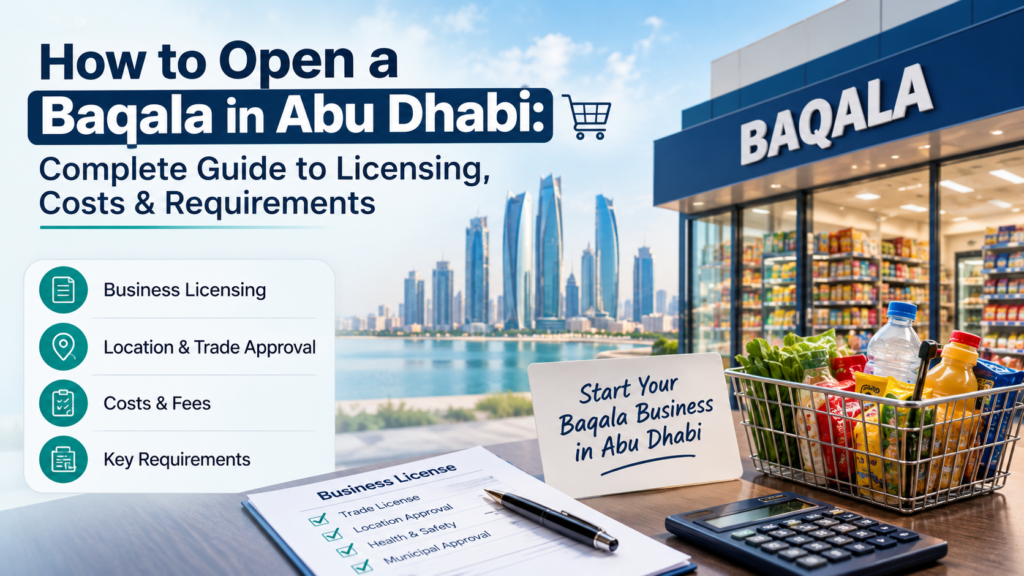
A neighborhood Baqala is often the first place residents visit for everyday essentials.
From fresh milk and bread in the morning to household items, snacks, and bottled water late at night, these convenience stores serve thousands of customers across Abu Dhabi every day.
Their accessibility and steady demand make them one of the most resilient retail business models in the UAE.
For entrepreneurs, opening a Baqala can be an attractive investment because it serves a recurring need rather than a seasonal trend.
However, success depends on much more than renting a shop and filling shelves with products.
You’ll need to choose the right business activity, secure the necessary trade license and approvals, comply with food safety regulations, plan your inventory carefully, and understand the costs involved before welcoming your first customer.
This comprehensive guide walks you through every stage of opening a Baqala in Abu Dhabi—from choosing the right location and obtaining your license to estimating startup costs, meeting legal requirements, and improving long-term profitability.
Whether you’re a UAE resident, an overseas investor, or an experienced retailer expanding into Abu Dhabi, you’ll find practical insights to help you make informed decisions and avoid costly mistakes.
What you’ll learn in this guide
- Who can open a Baqala in Abu Dhabi
- Licenses and approvals you’ll need
- Documents required for registration
- Estimated startup and operating costs
- Step-by-step registration process
- Common mistakes new owners make
- Practical ways to increase sales and profitability
- Ongoing compliance requirements after opening
What Is a Baqala?
A Baqala is a neighborhood convenience store that sells everyday essentials such as groceries, beverages, dairy products, snacks, fresh produce, household supplies, and personal care items. Unlike large supermarkets, a Baqala focuses on providing quick and convenient access to products that customers need on a daily basis.
These stores are commonly located within residential communities, apartment buildings, and mixed-use neighborhoods, allowing residents to purchase essential items without traveling long distances. Many Baqalas also offer home delivery services, making them an important part of everyday life in Abu Dhabi.
The popularity of Baqalas continues to grow because they combine convenience, accessibility, and extended operating hours. For entrepreneurs, this creates an opportunity to build a business that benefits from regular repeat customers and consistent demand throughout the year.
Planning to start another retail business? Visit Business Setup in Abu Dhabi.
What Products Can You Sell in a Baqala?
The products you can sell depend on your approved business activity and any additional permissions required by the relevant authorities. Most Baqalas typically stock a wide variety of daily essentials to meet the needs of nearby residents.
Common products include:
- Fresh fruits and vegetables
- Bread and bakery items
- Milk and dairy products
- Eggs
- Bottled water
- Soft drinks and juices
- Tea and coffee
- Rice, flour, sugar, and cooking oil
- Frozen food
- Snacks and confectionery
- Canned and packaged foods
- Cleaning supplies
- Personal hygiene products
- Baby care products
- Pet food (optional)
- Mobile recharge cards
- Basic household items
Depending on your business model and approvals, you may also be able to sell specialty or imported food products. If you plan to offer regulated products, ensure you obtain the necessary approvals from the relevant authorities before stocking them.
Why Are Baqalas So Popular in Abu Dhabi?
Despite the growth of supermarkets and online grocery platforms, Baqalas remain one of the most frequently visited retail businesses in Abu Dhabi. Their success comes from convenience rather than size.
Residents often prefer visiting a nearby Baqala for small daily purchases instead of driving to a large supermarket. This makes Baqalas an essential part of many residential communities.
Key reasons for their popularity include:
- Convenient locations within residential neighborhoods
- Quick shopping for daily essentials
- Extended operating hours
- Home delivery services offered by many stores
- Regular purchases from loyal local customers
- Lower travel time compared to large supermarkets
- Strong demand from families, professionals, and workers
For business owners, these factors can create a steady flow of repeat customers when the store is located in the right area and managed efficiently.
Is Opening a Baqala in Abu Dhabi a Good Business Opportunity?
A Baqala can be a profitable retail business because it serves everyday consumer needs. Unlike seasonal businesses, grocery stores benefit from recurring demand, as customers regularly purchase food, beverages, and household essentials.
However, profitability is influenced by several factors, including location, rental costs, competition, product selection, pricing strategy, and inventory management. A store in a high-density residential area with good visibility and convenient access generally has a better chance of attracting consistent foot traffic.
Successful Baqala owners also focus on customer service, maintaining fresh inventory, minimizing product waste, and offering convenient payment and delivery options. These operational decisions often have a greater impact on long-term success than simply obtaining a trade license.
Learn how to choose the right legal structure in our guide to Mainland Company Formation in Abu Dhabi.
Key Takeaways
 A Baqala is a neighborhood convenience store that serves daily consumer needs.
It offers a wide range of groceries, beverages, household products, and personal care items.
Strong demand comes from repeat customers and convenient locations.
Long-term success depends on choosing the right location, managing costs effectively, and delivering a reliable customer experience—not just obtaining a business license.
Who Can Open a Baqala in Abu Dhabi?
Opening a Baqala in Abu Dhabi is not limited to UAE nationals. Both local and foreign investors can establish a grocery retail business, provided they meet the licensing requirements and obtain the necessary approvals from the relevant authorities.
Before starting the registration process, it’s important to choose the correct business structure, business activity, and shop location. These decisions affect the approvals you’ll need and how quickly your application can be processed.
Whether you’re opening your first retail store or expanding an existing business, understanding the eligibility requirements can help you avoid unnecessary delays.
Can Foreigners Open a Baqala in Abu Dhabi?
Yes. Foreign investors can open a Baqala in Abu Dhabi by obtaining a mainland trade license for the approved retail activity and completing the required registration process.
In addition to the trade license, you may need approvals from other government authorities depending on the products you intend to sell and the nature of your business. Your retail premises must also comply with municipality and food safety requirements before operations can begin.
If you plan to relocate to the UAE to manage your business, you can also apply for the appropriate residency visa after your company is established, subject to the applicable immigration regulations.
Internal Link Suggestion:
Learn more about the process in our UAE Investor Visa Guide.
Eligibility Requirements to Open a Baqala
While the exact requirements may vary depending on your business structure, most applicants should be prepared to meet the following conditions.
Basic eligibility includes:
- A valid passport
- An approved business activity
- A registered trade name
- Initial approval from the licensing authority (where applicable)
- A commercial retail premises that meets local regulations
- A tenancy contract or lease agreement
- Required external approvals for food retail operations
- Compliance with municipality and food safety standards
Meeting these requirements early can help reduce delays during the licensing process.
Choosing the Right Business Structure
Selecting the right legal structure is one of the first decisions you’ll make. The best option depends on your investment goals, ownership preferences, and future expansion plans.
|
Business Structure |
Suitable for a Baqala? |
Best For |
|
Sole Establishment |
|
Individual entrepreneurs |
|
Limited Liability Company (LLC) |
|
Small and growing retail businesses |
|
Branch of an Existing Company |
|
Expanding an established business |
|
Free Zone Company |
|
Businesses that do not operate neighborhood retail stores |
 Generally not suitable
If you’re unsure which structure fits your business, it’s worth seeking professional advice before submitting your application. Changing the legal structure later may involve additional costs and approvals.
Compare your options in our guide to Mainland vs Free Zone Company Setup in the UAE.
Do You Need a Physical Shop?
Yes. A Baqala operates as a physical retail business, so you’ll need a commercial shop that complies with local zoning and licensing requirements.
When choosing a location, consider more than just the monthly rent. Factors such as customer foot traffic, parking availability, nearby residential buildings, visibility, storage space, and ease of deliveries can significantly influence your store’s long-term success.
Before signing a lease, confirm that the premises are suitable for your approved business activity and can obtain the necessary municipality and food safety approvals.
Before You Apply: A Quick Checklist
Before starting your application, make sure you have:
 Selected the correct business activity
- Decided on your business structure
- Chosen a suitable retail location
- Reserved your trade name
- Prepared the required identification documents
- Reviewed the approvals needed for your products
- Estimated your startup and operating budget
Completing these steps in advance can make the licensing process smoother and help you avoid unexpected delays.
Expert Tip
Many first-time business owners focus only on obtaining the trade license. In reality, choosing the right location, planning your budget, and understanding the approval process are equally important. Spending time on these decisions before applying can save both time and money during your business setup.
Step-by-Step Process to Open a Baqala in Abu Dhabi
Opening a Baqala in Abu Dhabi involves more than simply obtaining a trade license. You must choose the correct business activity, secure a suitable retail location, obtain government approvals, and ensure that the shop complies with food safety and municipality requirements. Following a structured process can help you avoid delays and unexpected costs.
Step 1: Research the Local Market
Before investing in a shop, evaluate whether the area has enough customer demand. A good location is often the biggest factor in the success of a neighborhood grocery store.
Check the following:
- Number of residential buildings nearby
- Population density
- Presence of families, workers, or students
- Existing Baqalas and supermarkets in the area
- Parking availability
- Pedestrian foot traffic
- Delivery accessibility
- Nearby schools, clinics, mosques, or parks
Avoid choosing a location based only on low rent. A slightly more expensive shop with strong daily foot traffic can generate significantly higher sales.
Step 2: Choose the Correct Business Activity
The business activity listed on your license determines what you are legally allowed to sell. For a Baqala, the activity usually falls under grocery or food retail trading.
Choosing the wrong activity can create problems later when applying for municipality or food safety approvals, so confirm the activity carefully before submitting your application.
Internal Link Suggestion:
Read our guide on Choosing the Right Business Activity in Abu Dhabi.
Step 3: Reserve Your Trade Name
Your business name must comply with UAE naming regulations. The name should not include offensive terms, religious references, or the names of well-known organizations without permission.
When selecting a name:
- Keep it easy to pronounce
- Make it relevant to retail or grocery trading
- Avoid overly long names
- Check availability before printing branding materials
Once approved, the trade name is reserved for your business registration process.
Step 4: Obtain Initial Approval
Initial approval confirms that the authorities have no objection to your proposed business activity. This is an important milestone before signing long-term lease agreements or investing in shop fit-out.
You will typically need:
- Passport copy
- Visa or entry status documents
- Proposed trade name
- Selected business activity
- Application forms required by the licensing authority
Step 5: Find a Suitable Retail Shop
Your premises must be appropriate for food and grocery retail operations. When evaluating a shop, pay attention to operational factors, not just the appearance of the location.
Important considerations:
- Visibility from the street
- Easy customer access
- Storage space for inventory
- Ventilation and sanitation facilities
- Space for refrigerators and freezers
- Delivery vehicle access
- Compliance with municipality regulations
A shop that requires extensive modifications may increase your startup costs considerably.
Step 6: Sign the Tenancy Contract
After selecting the shop, sign a commercial tenancy contract. This document is required for the trade license application and other approvals.
Make sure the contract:
- Is in the correct business name
- Clearly states the commercial use of the premises
- Covers a sufficient rental period
- Includes the correct property details
- Is registered as required by local regulations
Step 7: Apply for the Trade License
With the tenancy contract and initial approval in place, you can apply for the commercial trade license. The application is submitted through the relevant Abu Dhabi licensing authority.
Typical documents include:
- Passport copies of owners or partners
- Initial approval certificate
- Trade name reservation certificate
- Tenancy contract
- Memorandum of Association (for an LLC, where applicable)
- Additional forms required by the authority
Once approved and the fees are paid, the trade license is issued.
Step 8: Obtain Municipality Approval
Food retail businesses must comply with local municipality requirements related to hygiene, sanitation, waste disposal, and public health standards. The municipality may inspect the premises before granting approval.
Common requirements include:
- Cleanable wall and floor surfaces
- Proper drainage
- Adequate lighting
- Hand-washing facilities
- Waste management arrangements
- Pest control measures
Completing these requirements early can prevent delays in the opening process.
Step 9: Secure Food Safety Approval
Because a Baqala sells food products, food safety approval is typically required before operations can begin. The authorities may review your shop layout, storage facilities, refrigeration equipment, and hygiene procedures.
You may need to demonstrate:
- Safe food storage practices
- Temperature-controlled refrigeration
- Clean handling areas
- Proper shelving and separation of products
- Staff hygiene procedures
- Expiry date monitoring processes
Failure to meet food safety standards can result in delays, fines, or restrictions on the products you are allowed to sell.
Step 10: Meet Civil Defence Requirements
Retail premises may need to comply with fire and safety regulations. Depending on the size and layout of the shop, this can include:
- Fire extinguishers
- Emergency lighting
- Smoke detection systems
- Clear exit routes
- Electrical safety compliance
Always confirm the specific requirements for your premises before opening.
Step 11: Complete Shop Fit-Out and Equipment Installation
After obtaining the necessary approvals, prepare the store for operation. A well-organized layout improves both customer experience and operational efficiency.
Essential equipment usually includes:
- Shelving units
- Display racks
- Refrigerators and freezers
- Cash counter
- POS system
- Storage shelving
- Weighing scales (if selling produce)
- Security cameras
Keep walkways clear and place high-demand items where customers can easily find them.
Step 12: Register With Suppliers
Reliable suppliers are critical for maintaining consistent inventory. Compare multiple suppliers for pricing, delivery schedules, credit terms, and product quality.
For a new Baqala, it is often better to start with a focused product range rather than trying to stock every possible item immediately.
Prioritize fast-moving categories:
- Water and beverages
- Dairy products
- Bread and eggs
- Snacks
- Rice and cooking essentials
- Cleaning products
- Personal care items
Step 13: Set Up a POS and Inventory System
Manual billing becomes difficult as sales volume grows. A POS system helps with:
- Faster checkout
- Inventory tracking
- Sales reporting
- Barcode scanning
- Cash management
- Product performance analysis
Even a small neighborhood store benefits from accurate inventory records, which help reduce stock shortages and expired products.
Step 14: Hire Staff and Arrange Visas
If you plan to employ staff, ensure that all employment and immigration procedures are completed properly. Employees handling food products may also need health-related documentation depending on the applicable regulations.
Train staff on:
- Customer service
- Cash handling
- Hygiene standards
- Product storage procedures
- Expiry date checks
- Basic inventory management
Well-trained staff can significantly improve customer retention.
Step 15: Prepare for Opening Day
Before opening to customers, conduct a final operational review.
Opening checklist:
- Trade license displayed
- Municipality approval available
- Food safety approval completed
- Refrigeration functioning properly
- Inventory stocked and labeled
- Prices displayed clearly
- POS system tested
- Staff trained
- Cleaning completed
- Delivery process ready (if offered)
A smooth opening creates a positive first impression and helps establish trust with local residents.
Estimated Timeline
The actual timeline depends on document preparation, shop readiness, and approval processing, but a typical setup may look like this:
|
Stage |
Estimated Time |
|
Market research |
3-7 days |
|
Trade name & initial approval |
2-5 days |
|
Shop selection & tenancy |
3-10 days |
|
Trade license issuance |
3-7 days |
|
Municipality & food safety approvals |
5-15 days |
|
Fit-out & equipment installation |
7-20 days |
|
Final preparation |
2-3 days |
Typical total: 3-6 weeks for a well-prepared application and premises.
Common Mistakes During the Setup Process
New business owners often encounter delays because of avoidable errors.
Watch out for these issues:
- Signing a lease before confirming activity approval
- Choosing a shop that cannot meet food safety requirements
- Underestimating fit-out costs
- Overstocking inventory before understanding local demand
- Ignoring refrigeration and storage planning
- Delaying supplier negotiations
- Not budgeting for working capital after opening
Avoiding these mistakes can save both time and money during the launch phase.
Key Takeaways
Research the neighborhood before committing to a location.
Choose the correct grocery retail activity for your license.
Secure a compliant commercial premises.
Obtain trade license, municipality, and food safety approvals.
Install proper refrigeration, shelving, and POS systems.
Start with fast-moving inventory and reliable suppliers.
Expect the complete setup process to take approximately 3-6 weeks in most cases.
Cost to Open a Baqala in Abu Dhabi
The cost of opening a Baqala in Abu Dhabi varies depending on factors such as the shop size, location, business structure, fit-out requirements, inventory, and government fees. A small neighborhood store will generally require a lower investment than a larger grocery outlet with premium fixtures and extensive product lines.
Instead of focusing only on the trade license fee, you should prepare a complete startup budget that includes shop rent, equipment, inventory, approvals, and working capital for the first few months.
Planning your finances in advance helps reduce cash flow challenges after the business opens.
Estimated Startup Costs
The table below provides an estimated overview of the common expenses involved in setting up a Baqala.
|
Expense |
Estimated Cost (AED) |
|
Trade License |
Varies based on business activity |
|
Trade Name Reservation |
Government fee applicable |
|
Initial Approval |
Government fee applicable |
|
Commercial Shop Rent |
Depends on location and size |
|
Security Deposit |
Usually based on lease terms |
|
Shop Fit-Out |
Depends on store condition |
|
Shelving & Display Racks |
Based on store size |
|
Refrigerators & Freezers |
Depends on equipment selection |
|
POS System |
Varies by software and hardware |
|
Initial Inventory |
Based on product range |
|
Municipality & External Approvals |
Applicable where required |
|
Signboard Installation |
Depends on design and size |
|
Working Capital |
Recommended for the first few months |
Important: Actual costs depend on your business requirements, the selected premises, government fees, and supplier pricing. Obtain updated quotations before making financial commitments.
One-Time vs Recurring Costs
Understanding the difference between startup and ongoing expenses will help you prepare a realistic business budget.
One-Time Costs
These are expenses paid before or during the setup process.
- Trade license registration
- Trade name reservation
- Shop fit-out
- Shelving and fixtures
- Refrigeration equipment
- POS system
- Security deposit
- Initial inventory
- Signboard installation
Recurring Monthly Costs
These continue after the store starts operating.
- Shop rent
- Employee salaries
- Utility bills
- Inventory replenishment
- Internet and telephone
- Delivery expenses
- Equipment maintenance
- Accounting and bookkeeping
- Marketing and promotions
- License renewal (annual planning)
Separating these expenses makes it easier to estimate how much working capital you’ll need after opening.
Hidden Costs Many New Owners Forget
Many first-time entrepreneurs only budget for the trade license and shop rent. However, several additional expenses can affect your cash flow during the first few months.
Common hidden costs include:
- Store branding and signage
- Barcode labels and pricing materials
- Shopping baskets and trolleys
- Cleaning equipment and supplies
- Pest control services
- Insurance (where applicable)
- Packaging materials
- Staff uniforms
- Product spoilage and expired inventory
- Maintenance and equipment repairs
Adding a contingency fund to your budget can help cover unexpected expenses without disrupting business operations.
How Much Working Capital Do You Need?
A Baqala usually requires ongoing cash flow because inventory needs to be replenished regularly while operating expenses continue every month.
It is generally advisable to keep enough working capital to cover:
- Rent
- Staff salaries
- Utility bills
- Supplier payments
- Inventory restocking
- Unexpected maintenance costs
Having a financial buffer allows you to manage slower sales periods without affecting daily operations.
Tips to Reduce Startup Costs
You don’t always need the highest investment to build a successful Baqala. Careful planning can help you control costs without compromising customer experience.
Consider these practical tips:
- Choose a shop that requires minimal renovation.
- Compare multiple suppliers before placing your first order.
- Purchase inventory based on expected demand instead of overstocking.
- Invest in energy-efficient refrigeration equipment.
- Negotiate favorable payment terms with suppliers.
- Use a reliable POS system to reduce inventory losses.
- Expand your product range gradually based on customer demand.
A disciplined approach to spending often produces better long-term results than investing heavily from day one.
Should You Buy or Lease Equipment?
For many new businesses, leasing certain equipment may reduce the initial investment. However, buying essential items such as shelving and display racks can be more cost-effective over the long term.
Before making a decision, compare:
- Initial cost
- Maintenance responsibility
- Warranty coverage
- Replacement costs
- Long-term value
The right option depends on your available budget and business plan.
Expert Tip
The cheapest setup is not always the most profitable. A store located in a busy residential area with the right product mix can generate stronger long-term returns than a lower-cost shop in a location with limited customer traffic.
When planning your investment, focus on total business viability rather than simply reducing startup expenses.
Before finalizing your budget, read our guide on Business Setup Costs in Abu Dhabi to understand other expenses that may apply during company formation.
Key Takeaways
Startup costs vary depending on location, shop size, equipment, and inventory.
Budget for both one-time setup costs and recurring monthly expenses.
Keep sufficient working capital for the first few months of operation.
Avoid underestimating hidden costs such as maintenance, signage, and inventory losses.
Careful financial planning can improve long-term business stability.
Documents Required to Open a Baqala in Abu Dhabi
Preparing the required documents before starting your application can significantly reduce processing delays. While the exact documentation may vary depending on your business structure and ownership, most applicants will need to submit identity documents, business registration paperwork, and proof of a commercial premises.
If any document is missing or contains incorrect information, the licensing authority may request revisions before processing your application.
Read our detail guide Documents Required for Mainland Business Setup in Abu Dhabi
Document Checklist
Use the checklist below to ensure you have all the required documents ready before applying for your Baqala license.
|
Document |
Purpose |
|
Valid Passport Copy |
Identity verification of the owner or partners |
|
UAE Visa Copy (if applicable) |
Confirms residency status where required |
|
Emirates ID (if applicable) |
Identity verification for UAE residents |
|
Passport-sized Photograph |
Required for certain government applications |
|
Trade Name Reservation Certificate |
Confirms your approved business name |
|
Initial Approval Certificate |
Indicates approval to proceed with registration |
|
Commercial Tenancy Contract |
Proof of business premises |
|
Memorandum of Association (LLC only) |
Defines company ownership and structure |
|
External Approval Documents (if applicable) |
Required for regulated business activities |
|
Additional Government Forms |
As requested during the application process |
Note: The required documents may vary depending on the legal structure of your company and the approvals applicable to your business activity.
Understanding Each Document
Knowing why each document is required can help you prepare your application more efficiently.
Passport Copy
Every owner or shareholder must provide a valid passport copy. Ensure that the passport is clear, legible, and valid at the time of submission.
UAE Visa and Emirates ID
If you are already residing in the UAE, you may be asked to provide copies of your visa and Emirates ID during the registration process.
Foreign investors applying from outside the UAE may follow a different process depending on their immigration status.
Trade Name Reservation Certificate
This certificate confirms that your chosen business name has been approved and reserved.
Before submitting your application, verify that the trade name matches the name used on all supporting documents.
Initial Approval Certificate
Initial approval indicates that the authorities have no objection to your proposed business activity.
This approval allows you to continue with the remaining licensing requirements, including leasing a commercial premises and obtaining external approvals where necessary.
Commercial Tenancy Contract
A Baqala must operate from a licensed commercial premises.
Your tenancy contract serves as proof that you have secured a suitable retail location for your business.
Before signing the lease, confirm that the premises are appropriate for grocery retail operations and comply with local regulations.
Memorandum of Association (LLC)
If your business is registered as a Limited Liability Company (LLC), you’ll generally need a Memorandum of Association (MOA).
This document outlines important information such as:
- Company ownership
- Shareholding percentages
- Business activities
- Management responsibilities
External Approval Documents
Some grocery-related activities may require approvals from additional government authorities before operations can begin.
The exact approvals depend on the products you intend to sell and the applicable regulatory requirements.
Obtaining these approvals early can help prevent delays later in the licensing process.
Tips for Preparing Your Documents
Before submitting your application, review every document carefully.
Best practices include:
- Use clear, high-quality document copies.
- Ensure names match across all documents.
- Verify passport validity before applying.
- Double-check business activity details.
- Confirm your tenancy contract contains accurate property information.
- Keep both digital and printed copies of important documents.
- Organize documents in the order requested by the licensing authority.
A well-prepared application is generally processed more smoothly than one requiring multiple corrections.
Common Documentation Mistakes
Many licensing delays occur because of simple documentation errors.
Avoid these common mistakes:
- Submitting expired passport copies
- Incorrect spelling of the business name
- Mismatched owner information
- Missing signatures on legal documents
- Incomplete tenancy agreements
- Choosing a business activity that doesn’t match the intended operations
- Waiting until the last minute to obtain external approvals
Reviewing your application before submission can save valuable time during the registration process.
Can Someone Help With the Documentation?
Yes. Many entrepreneurs choose to work with a business setup consultant to manage document preparation and coordinate the application process.
Professional assistance can help:
- Verify document accuracy
- Recommend the correct business activity
- Coordinate government approvals
- Reduce application errors
- Save time during registration
This is particularly useful for first-time investors or overseas applicants who may be unfamiliar with local procedures.
Check out our Business Setup Services in Abu Dhabi to learn how our team assists with documentation, licensing, and government approvals.
Key Takeaways
Prepare all required documents before starting your application.
Ensure every document contains consistent information.
Secure your tenancy contract before proceeding with the trade license application.
Obtain any required external approvals as early as possible.
A complete and accurate application can help reduce processing delays.
Licenses and Government Approvals Required to Open a Baqala in Abu Dhabi
A Baqala is a regulated retail business that sells food and daily consumer products. Because of this, obtaining a trade license alone is usually not enough. Depending on your business activity and the products you plan to sell, you may also need approvals from other government authorities before opening your store.
Understanding these requirements early can help you avoid delays, unexpected costs, and compliance issues.
1. Commercial Trade License
The commercial trade license is the primary license that allows you to legally operate a Baqala in Abu Dhabi.
It confirms your business activity, legal structure, and registered business details. Without a valid trade license, you cannot legally conduct business operations.
A trade license typically includes information such as:
- Business name
- Business activity
- Legal structure
- Owner or shareholder details
- Business location
- License validity period
Once your trade license is issued, you can move forward with the remaining approvals required for your grocery store.
Internal Link Suggestion:
Learn more about the complete Trade License Process in Abu Dhabi.
2. Municipality Approval
Since a Baqala serves the public, your retail premises must meet municipality requirements before operations begin.
The municipality reviews whether the shop complies with health, sanitation, and operational standards.
Typical inspection areas include:
- Shop cleanliness
- Flooring and wall finishes
- Ventilation
- Waste disposal arrangements
- Water supply
- Storage facilities
- Customer safety
- General hygiene
Preparing your shop before the inspection can help reduce approval delays.
3. Food Safety Approval
Food safety is one of the most important requirements for a grocery business.
If your Baqala stores or sells food products, the relevant authority may inspect your premises to ensure food is handled, stored, and displayed safely.
During inspection, officials may review:
- Refrigeration temperatures
- Frozen food storage
- Food shelving
- Product segregation
- Expiry date management
- Hygiene procedures
- Cleaning practices
- Pest control measures
Maintaining proper food safety standards not only supports compliance but also builds customer trust.
4. Civil Defence Approval (Where Applicable)
Some retail premises may also need to comply with fire and life safety requirements before opening.
Depending on your premises, authorities may inspect:
- Fire extinguishers
- Emergency exits
- Smoke detection systems
- Electrical installations
- Emergency lighting
- Fire safety signage
Meeting these requirements helps protect employees, customers, and business assets.
5. Commercial Signboard Approval
Before installing your shop’s exterior signage, you may need approval to ensure it complies with local regulations.
The approval process may consider:
- Sign dimensions
- Placement
- Language requirements
- Building regulations
- Safety standards
Installing signage without approval could lead to penalties or the need for modifications.
6. Employee and Immigration Requirements
If you plan to hire staff, additional procedures may apply before employees begin work.
These can include:
- Employment documentation
- Residency visa processing
- Labour registration
- Medical examinations (where applicable)
- Identity documentation
Completing these formalities ensures your workforce is legally authorized to work.
Internal Link Suggestion:
Read our guide on UAE Employment Visas for Businesses.
7. Tax Registration (If Applicable)
Depending on your business turnover and applicable regulations, you may need to register for VAT and comply with UAE Corporate Tax requirements.
Your responsibilities may include:
- Maintaining financial records
- Issuing tax-compliant invoices
- Filing tax returns where applicable
- Keeping accounting records
- Meeting reporting deadlines
Consulting a qualified tax professional can help ensure ongoing compliance as your business grows.
Learn more about VAT Registration in the UAE and UAE Corporate Tax Services.
Which Government Authorities May Be Involved?
The exact authorities depend on your business activity, but a typical Baqala setup may involve the following.
|
Authority |
Primary Responsibility |
|
Department of Economic Development (or the relevant licensing authority) |
Business registration and trade license |
|
Municipality |
Shop inspection and public health compliance |
|
Food Safety Authority |
Food handling and storage compliance |
|
Civil Defence |
Fire and life safety requirements |
|
Immigration & Labour Authorities |
Employee visas and labour procedures |
|
Federal Tax Authority (where applicable) |
VAT and tax compliance |
Note: The approvals required for your business may vary depending on your products, premises, and business activity.
Typical Approval Workflow
Understanding the sequence of approvals helps you prepare your application more efficiently.
Choose Business Activity
↓
Reserve Trade Name
↓
Obtain Initial Approval
↓
Lease Commercial Premises
↓
Apply for Trade License
↓
Complete Shop Fit-Out
↓
Municipality Inspection
↓
Food Safety Approval
↓
Civil Defence Compliance (if required)
↓
Install Shop Signboard
↓
Hire Employees
↓
Open Your Baqala
Following the correct order reduces the likelihood of delays or repeated inspections.
How Long Does the Approval Process Take?
The overall timeline depends on several factors, including:
- Accuracy of your application
- Availability of required documents
- Readiness of the shop
- Inspection schedules
- Additional approvals for specific products
A well-prepared application with a compliant retail premises is generally processed more quickly than one requiring corrections or additional inspections.
How a Business Setup Consultant Can Help
Managing multiple approvals can be challenging, especially for first-time entrepreneurs or overseas investors.
A business setup consultant can assist by:
- Identifying the correct business activity
- Preparing and reviewing documentation
- Coordinating government approvals
- Following up on application status
- Helping avoid common compliance issues
- Reducing unnecessary delays
Professional support allows you to focus on planning your business while the administrative process is managed efficiently.
Internal Link Suggestion:
Explore our Business Setup Services in Abu Dhabi to learn how we can assist with licensing, approvals, and company registration.
Key Takeaways
A trade license is only one part of the setup process.
Most Baqalas also require municipality and food safety compliance before opening.
Additional approvals may apply depending on your shop and business activity.
Preparing your premises before inspections can reduce delays.
Following the correct approval sequence makes the registration process smoother.
How to Choose the Best Location for Your Baqala in Abu Dhabi
The success of a Baqala depends heavily on its location. Even a well-stocked store with competitive prices can struggle if it’s in an area with limited customer traffic or strong competition.
Before signing a tenancy agreement, spend time evaluating the neighborhood, customer demand, and nearby businesses. Choosing the right location from the beginning can improve sales, reduce marketing costs, and help build a loyal customer base.
Why Location Matters
Unlike many businesses that rely on occasional purchases, a Baqala depends on repeat customers who buy groceries and household essentials several times a week.
A convenient location encourages customers to return regularly, while an inconvenient location may lead them to choose another nearby store.
The right location can help you:
- Build a loyal customer base
- Increase daily walk-in sales
- Improve home delivery efficiency
- Generate repeat purchases
- Strengthen long-term profitability
Key Factors to Evaluate Before Renting a Shop
Don’t choose a shop based on rent alone. Consider the following factors before making your decision.
1. Residential Population
A Baqala performs best in neighborhoods with a steady residential population.
Look for areas with:
- Apartment buildings
- Villa communities
- Staff accommodations
- Mixed-use developments
- Newly developed residential projects
More residents generally mean more opportunities for repeat business.
2. Daily Foot Traffic
Observe the area during different times of the day.
Visit:
- Early morning
- Afternoon
- Evening
- Weekdays
- Weekends
This helps you understand when people are most active and whether the location attracts consistent visitors.
3. Nearby Competition
Competition isn’t always a disadvantage.
A neighborhood with several grocery stores often indicates strong customer demand. However, avoid opening directly next to an established Baqala unless you have a clear strategy to differentiate your business.
When assessing competitors, consider:
- Store size
- Product variety
- Pricing
- Customer service
- Opening hours
- Delivery options
- Customer reviews
Understanding the market helps you identify opportunities to offer something better.
4. Visibility
A shop that is easy to see is more likely to attract walk-in customers.
Look for a location with:
- Clear road visibility
- Corner frontage (where possible)
- Large display windows
- Space for attractive signage
- Good lighting at night
Customers should be able to identify your store quickly without searching for it.
5. Parking and Accessibility
Convenience is one of the biggest reasons customers choose a Baqala.
Check whether the location offers:
- Nearby parking
- Safe pedestrian access
- Easy vehicle entry
- Delivery vehicle access
- Accessibility for elderly customers and families
If reaching your shop is difficult, customers may choose a more convenient alternative.
6. Delivery Potential
Home delivery has become an important service for many neighborhood grocery stores.
Choose a location that allows efficient deliveries to nearby communities.
A central location can help reduce delivery times and improve customer satisfaction.
7. Rental Cost
Lower rent doesn’t always mean lower operating costs.
A shop with slightly higher rent in a busy residential area may generate significantly more sales than a cheaper shop with limited customer traffic.
Instead of asking:
“Which shop has the lowest rent?”
Ask:
“Which shop has the highest earning potential?”
This shift in thinking can make a significant difference to your long-term success.
Location Evaluation Checklist
Before signing your tenancy agreement, review the following checklist.
|
Evaluation Factor |
Yes |
No |
|
High residential population nearby |
☐ |
☐ |
|
Good pedestrian traffic |
☐ |
☐ |
|
Easy customer access |
☐ |
☐ |
|
Convenient parking |
☐ |
☐ |
|
Strong road visibility |
☐ |
☐ |
|
Suitable delivery access |
☐ |
☐ |
|
Limited direct competition |
☐ |
☐ |
|
Commercially approved premises |
☐ |
☐ |
|
Space for storage |
☐ |
☐ |
|
Affordable long-term rent |
☐ |
☐ |
If you answer “Yes” to most of these questions, the location is likely to be a stronger candidate for your Baqala.
Common Location Mistakes to Avoid
Many new business owners rush into signing a lease without properly evaluating the area.
Avoid these common mistakes:
- Choosing the cheapest available shop
- Ignoring nearby competition
- Underestimating parking challenges
- Renting a space with limited storage
- Selecting a location with poor visibility
- Failing to observe customer traffic at different times
- Not confirming the premises are suitable for grocery retail
Taking time to research before signing a lease can save significant costs later.
Read: Common Mistakes in Mainland Business Setup in Abu Dhabi
Expert Tips for Choosing a Profitable Location
Before making your final decision, spend several days visiting the neighborhood.
You can also:
- Speak with nearby shop owners
- Observe customer buying patterns
- Check future residential developments
- Review local demographics
- Estimate daily pedestrian traffic
- Assess opportunities for home delivery
The more information you gather before investing, the better your chances of selecting a profitable location.
Internal Link Suggestion:
Before signing your lease, read our guide on Mainland Company Formation in Abu Dhabi to understand how your business location can affect licensing and approvals.
Key Takeaways
Location is one of the biggest factors affecting a Baqala’s success.
Prioritize customer convenience over lower rent.
Evaluate foot traffic, residential density, competition, visibility, and accessibility.
Visit the area at different times before making a decision.
Choose a location that supports both walk-in customers and home delivery.
How to Make Your Baqala Profitable
Opening a Baqala is only the first step. Long-term success depends on how efficiently you manage inventory, control expenses, and create a shopping experience that encourages customers to return.
A profitable Baqala is built on consistent daily sales, repeat customers, and smart business decisions rather than simply offering the lowest prices.
Below are practical strategies that can help improve your store’s performance.
1. Stock Fast-Moving Products First
One of the biggest mistakes new owners make is purchasing too many slow-selling products.
Instead, focus on items customers buy regularly.
High-demand products include:
- Bottled water
- Milk and dairy products
- Bread
- Eggs
- Rice and flour
- Cooking oil
- Tea and coffee
- Snacks and chocolates
- Soft drinks
- Frozen food
- Cleaning supplies
- Personal care products
These products generate frequent repeat purchases and help maintain steady cash flow.
2. Understand Customer Buying Habits
Every neighborhood has different shopping patterns.
For example:
- Families often purchase groceries in larger quantities.
- Office workers may buy snacks and ready-to-eat meals.
- Students usually prefer affordable food and beverages.
- Labour accommodation areas often have high demand for daily essentials and low-cost grocery items.
Monitor your sales reports and adjust your inventory based on local demand.
3. Reduce Product Waste
Expired inventory directly affects profitability.
Create a routine for checking expiry dates and rotate products using the First In, First Out (FIFO) method.
You should also:
- Inspect shelves daily
- Store products correctly
- Offer promotions on products approaching expiry (where legally appropriate)
- Avoid over-ordering seasonal items
Reducing waste improves your profit margin without increasing sales.
4. Build Strong Supplier Relationships
Reliable suppliers play an important role in controlling costs.
Compare suppliers based on:
- Product quality
- Delivery reliability
- Payment terms
- Pricing
- Minimum order quantities
Review supplier performance regularly and negotiate better terms as your purchase volume grows.
5. Offer Home Delivery
Many customers prefer ordering groceries without leaving home.
Providing a simple delivery service can help you:
- Increase order value
- Reach elderly customers
- Serve busy professionals
- Build customer loyalty
Even delivery within a small radius can become an additional source of revenue.
6. Accept Multiple Payment Methods
Modern customers expect flexible payment options.
Consider accepting:
- Cash
- Debit cards
- Credit cards
- Mobile payment solutions
- Digital wallets
Providing convenient payment options improves the shopping experience and reduces abandoned purchases.
7. Keep Your Store Clean and Well Organised
Customers are more likely to return to a clean and organised store.
Simple improvements include:
- Clearly labelled shelves
- Bright lighting
- Wide walkways
- Fresh product displays
- Clean refrigeration units
- Visible pricing
A well-maintained store also creates a positive first impression for new customers.
8. Train Your Staff
Friendly and knowledgeable employees encourage repeat business.
Staff should understand:
- Customer service
- Product locations
- Food hygiene practices
- Cash handling procedures
- Inventory management
- Complaint resolution
Well-trained employees can improve both customer satisfaction and operational efficiency.
9. Promote Your Baqala Locally
You don’t need a large marketing budget to attract nearby customers.
Consider:
- Creating a Google Business Profile
- Encouraging customer reviews
- Distributing flyers in nearby residential buildings
- Running seasonal promotions
- Displaying attractive in-store offers
- Using WhatsApp Business to share weekly promotions
Small marketing efforts can increase visibility within your local community.
10. Use a POS System to Monitor Performance
A Point of Sale (POS) system does more than process payments.
It helps you:
- Track daily sales
- Identify best-selling products
- Monitor inventory levels
- Reduce stock shortages
- Generate financial reports
- Improve purchasing decisions
Using real sales data allows you to make informed business decisions instead of relying on guesswork.
Common Profit-Killing Mistakes
Avoid these common errors that reduce profitability.
- Overstocking slow-moving products
- Ignoring expiry dates
- Pricing products without considering margins
- Ordering from a single supplier without comparing prices
- Poor customer service
- Weak inventory control
- Inconsistent store opening hours
- Failing to monitor daily sales
- Neglecting store cleanliness
- Ignoring customer feedback
Identifying and correcting these issues early can improve long-term business performance.
Monthly Profitability Checklist
Use this checklist every month to monitor your store’s performance.
|
Checklist |
Status |
|
Fast-moving products always available |
☐ |
|
Expired products removed |
☐ |
|
Supplier prices reviewed |
☐ |
|
Sales reports analysed |
☐ |
|
Inventory levels checked |
☐ |
|
Store cleaned daily |
☐ |
|
Customer complaints resolved |
☐ |
|
Promotional offers updated |
☐ |
|
Utility expenses monitored |
☐ |
|
Profit margins reviewed |
☐ |
Regular reviews help identify problems before they affect your business.
Expert Tips for Long-Term Success
Successful Baqala owners focus on building customer trust rather than chasing short-term profits.
Some practical ways to stand out include:
- Remember regular customers and their preferences.
- Keep essential products in stock at all times.
- Introduce new products based on customer requests.
- Maintain transparent pricing.
- Deliver orders on time.
- Respond quickly to customer feedback.
- Review sales trends every month.
Over time, these small improvements can create a loyal customer base and support sustainable growth.
Key Takeaways
Focus on products that customers purchase regularly.
Monitor inventory to reduce waste and improve cash flow.
Build reliable supplier relationships to control costs.
Offer convenient payment methods and home delivery.
Use technology and sales reports to make better business decisions.
Deliver excellent customer service to encourage repeat business.
Once your store is operational, learn about VAT Registration in the UAE and Accounting & Bookkeeping Services to keep your business compliant and financially organized.
Common Mistakes to Avoid When Opening a Baqala in Abu Dhabi
Starting a grocery business requires careful planning. While obtaining a trade license is an important milestone, many new business owners face challenges because of avoidable mistakes during the setup and operational stages.
Learning from these common mistakes can help you save time, reduce costs, and improve your chances of building a successful business.
1. Choosing the Wrong Location
A low rental price may seem attractive, but poor visibility or limited customer traffic can significantly affect sales.
Before signing a lease, evaluate:
- Residential population
- Foot traffic
- Parking availability
- Nearby competition
- Accessibility
- Delivery potential
A well-located store often performs better than a larger store in a less suitable area.
2. Underestimating Startup Costs
Many entrepreneurs only budget for the trade license and rent.
However, additional expenses such as shop fit-out, refrigeration, inventory, staff salaries, utilities, and working capital should also be included in your financial plan.
Creating a detailed budget before opening helps avoid cash flow problems.
3. Overstocking Slow-Moving Products
Purchasing too much inventory during the initial setup can tie up valuable capital.
Instead:
- Start with essential products.
- Monitor customer demand.
- Increase inventory gradually.
- Review sales reports regularly.
This approach reduces waste and improves cash flow.
4. Ignoring Food Safety Standards
Food safety compliance is essential for any grocery business.
Poor storage practices, expired products, or inadequate hygiene procedures can result in penalties and damage your reputation.
Develop clear procedures for:
- Stock rotation
- Temperature monitoring
- Cleaning schedules
- Expiry date checks
- Pest control
5. Poor Inventory Management
Running out of popular products can frustrate customers, while excess stock increases storage costs and waste.
Using a POS and inventory management system helps you:
- Monitor stock levels
- Identify fast-moving products
- Track expiry dates
- Improve purchasing decisions
6. Focusing Only on Price
Competing only on price can reduce your profit margins.
Customers also value:
- Friendly service
- Product availability
- Clean premises
- Quick checkout
- Home delivery
- Convenient payment options
A better customer experience often leads to stronger customer loyalty.
7. Not Promoting the Business
Even a well-stocked Baqala needs local visibility.
Simple marketing strategies include:
- Optimizing your Google Business Profile
- Encouraging customer reviews
- Running seasonal promotions
- Using WhatsApp Business
- Displaying attractive in-store offers
Consistent local marketing can help attract new customers and increase repeat visits.
8. Delaying License Renewals
Business licenses and other approvals have renewal deadlines.
Missing renewal dates may lead to penalties or interruptions in business operations.
Keep a compliance calendar to track:
- Trade license renewal
- Tenancy renewal
- Employee documentation
- Tax filing deadlines
- Other regulatory obligations
Quick Success Checklist
Before opening your Baqala, make sure you can answer “Yes” to the following questions.
|
Question |
Yes |
No |
|
Have you selected the right location? |
☐ |
☐ |
|
Is your startup budget complete? |
☐ |
☐ |
|
Have you obtained all required approvals? |
☐ |
☐ |
|
Is your shop ready for inspection? |
☐ |
☐ |
|
Have you finalized supplier agreements? |
☐ |
☐ |
|
Is your POS system installed? |
☐ |
☐ |
|
Have you hired and trained staff? |
☐ |
☐ |
|
Is your opening inventory planned? |
☐ |
☐ |
|
Do you have a marketing plan? |
☐ |
☐ |
|
Have you allocated working capital? |
☐ |
☐ |
Completing this checklist can help you launch your business with greater confidence.
Frequently Asked Questions (FAQs)
Can a foreign investor open a Baqala in Abu Dhabi?
Yes. Foreign investors can open a Baqala by completing the required business registration process, obtaining the appropriate trade license, and securing any additional approvals required for food retail operations.
Do I need a physical shop to operate a Baqala?
Yes. A Baqala is a retail business that must operate from a licensed commercial premises that complies with local regulations.
How long does it take to open a Baqala?
The timeline depends on document preparation, approvals, and shop readiness. Many businesses complete the setup process within 3 to 6 weeks, although complex cases may take longer.
What products can I sell in a Baqala?
Most Baqalas sell groceries, dairy products, beverages, snacks, frozen food, household essentials, and personal care products. The exact product range depends on your licensed business activity and any additional approvals.
Do I need food safety approval?
If your business sells food products, you may need to comply with applicable food safety requirements before beginning operations.
Yes. Many Baqalas offer home delivery to nearby customers, provided they comply with applicable business and delivery regulations.
Is a Baqala business profitable?
A Baqala can be profitable when it is located in a high-demand area, managed efficiently, and focused on customer service, inventory control, and cost management.
How many employees can I hire?
The number of employees depends on factors such as your business requirements, operational needs, and applicable employment regulations.
Do I need to register for VAT?
VAT registration depends on your taxable turnover and applicable UAE tax regulations. Businesses should assess their obligations and register when required.
Internal Link Suggestion:
Read our VAT Registration Guide for more information.
Need Help Opening a Baqala in Abu Dhabi?
Setting up a grocery business involves multiple steps, from selecting the correct business activity and obtaining a trade license to coordinating municipality and food safety approvals.
At Ofin Global, our business setup specialists can help you:
- Choose the right business structure
- Register your company
- Obtain the required licenses and approvals
- Prepare documentation
- Coordinate with relevant authorities
- Support you through the setup process from start to finish
Speak with our team today to simplify your business setup journey and start your Baqala with confidence.
How to Open a Baqala in Abu Dhabi
Discover licensing requirements, setup costs, required documents, approvals, and expert tips to start your grocery business successfully.
Our expert will contact you within 24 hours!
[forminator_form id=”1254″]
Recent Post
-

Dubai Mainland Company Formation Cost 2026: Complete Breakdown
-
How to Open a Baqala in Abu Dhabi: Complete Guide to Licensing, Costs & Requirements
-
Emirates ID Status Check Online (2026): Track Your Application, Understand Every Status & Resolve Delays
-
RAK ICC Offshore Company Setup in the UAE: The Complete Guide for Global Entrepreneurs (2026)
-

How to Apply for a Tax Penalty Waiver in the UAE